

At Yale’s Buddhist shrine, students escape campus’s productivity culture.
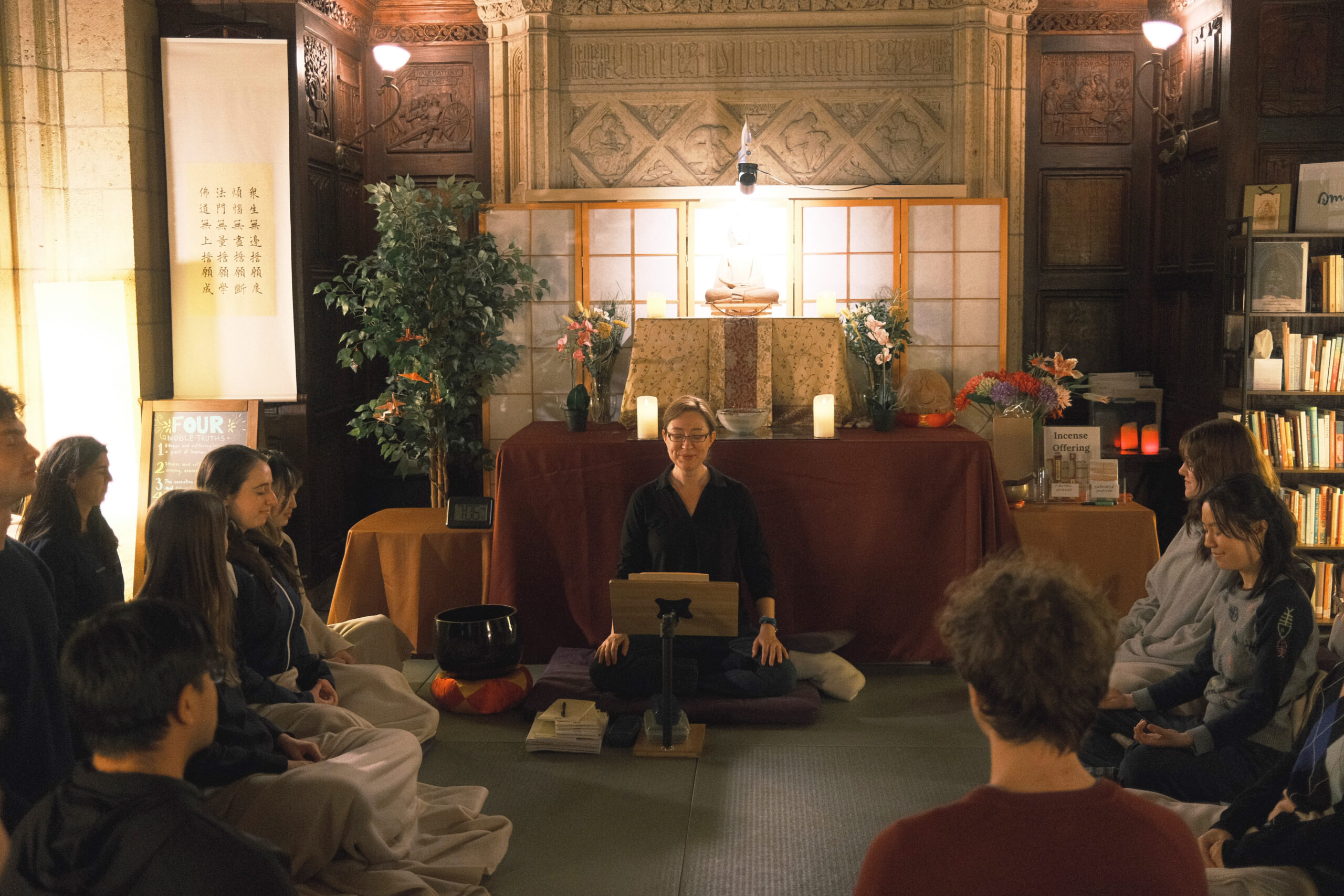
Inside the base of Harkness Tower, stone walls arch up toward the ceiling. At night a large stained glass window on the left wall lies in shadow. The room is a Buddhist shrine, but it is also a shrine to Yale. Stone and wood-paneled walls. The quintessential Yale fireplace, hidden behind a folding screen. A dedication to Charles William Harkness inscribed on the chimney.
Every Wednesday and Sunday evening, Reverend Sumi Kim, Yale’s Buddhist Chaplain, leads an hourlong meditation workshop. Around three dozen undergraduate and graduate students usually show up. Some are Buddhist. Most are not. They aim to free themselves, in Kim’s words, from “craving” or “clinging” to material goals. But Yale students often cling and crave, seeking perfection in their relationships, schoolwork, job searches, extracurriculars—and even meditation.
Kim sits at the front, back straight. She has a strawberry blond bob and thin rectangular glasses. We sit criss-cross on cushions and low chairs in a semicircle around her. Kim puts us at ease with her quiet humor. The Wednesday after the Super Bowl, she said, “I feel like if Mr. Bunny had been here, he would have done the ‘lovingkindness’ meditation and turned into a Good Bunny.”
Kim became Yale’s Buddhist chaplain in 2018, having previously served as the Buddhist chaplain at Duke University. She now oversees the Buddhist Life program, founded in 2012 under the Yale Chaplain’s Office. Her responsibilities include leading the shrine, providing pastoral counseling, and visiting Yale classes.
Before meditations she welcomes each student into the shrine, often by name. On Sundays, she chats with students as they leave the social hour in the adjoining Trumbull Room, where they mingle over tea and mochi. Kim estimates that only 1 in 5 of her students come from a Buddhist family or tradition. The rest either come from another faith or don’t identify with any particular religion. In her eight years here, Kim’s approach has remained largely the same. “The questions of a 20-year-old in 1980 are the same as [in] 1990, 2000, 2010, 2020,” Kim said. “What is my purpose in life? Who am I? Like, how do I understand myself?”
Kim believes that even students who previously identified as Buddhist should take their time at Yale to recreate their relationship to Buddhism, as they grow intellectually and emotionally. She was raised in a Zen Buddhist community in rural New Hampshire but practiced the Theravada lineage as a teenager, enjoying it because it was “low, gentle, step-by-step.”
Originating in the Indian subcontinent more than 2,500 years ago, Buddhism explores suffering, its causes, and practices to overcome it. The Buddha, Siddhartha Gautama, proposed Four Noble Truths, which are listed on a blackboard in the shrine: Life involves suffering. Suffering comes from desire. Suffering can be overcome by letting go of attachment. Lastly, the Buddha proposed an Eightfold Path, a guide to thought, action, and mindfulness designed to end suffering.
In the spring, Kim teaches metta, or lovingkindness meditation. Metta is a Pali, or ancient Buddhist, word meaning “friend” or “friendliness.” We wish specific people happiness, health, safety, and a fourth wish of their choosing. Sometimes Kim asks us to picture a mentor, a stranger, or a challenging figure, like an estranged friend. She always asks us to picture ourselves.
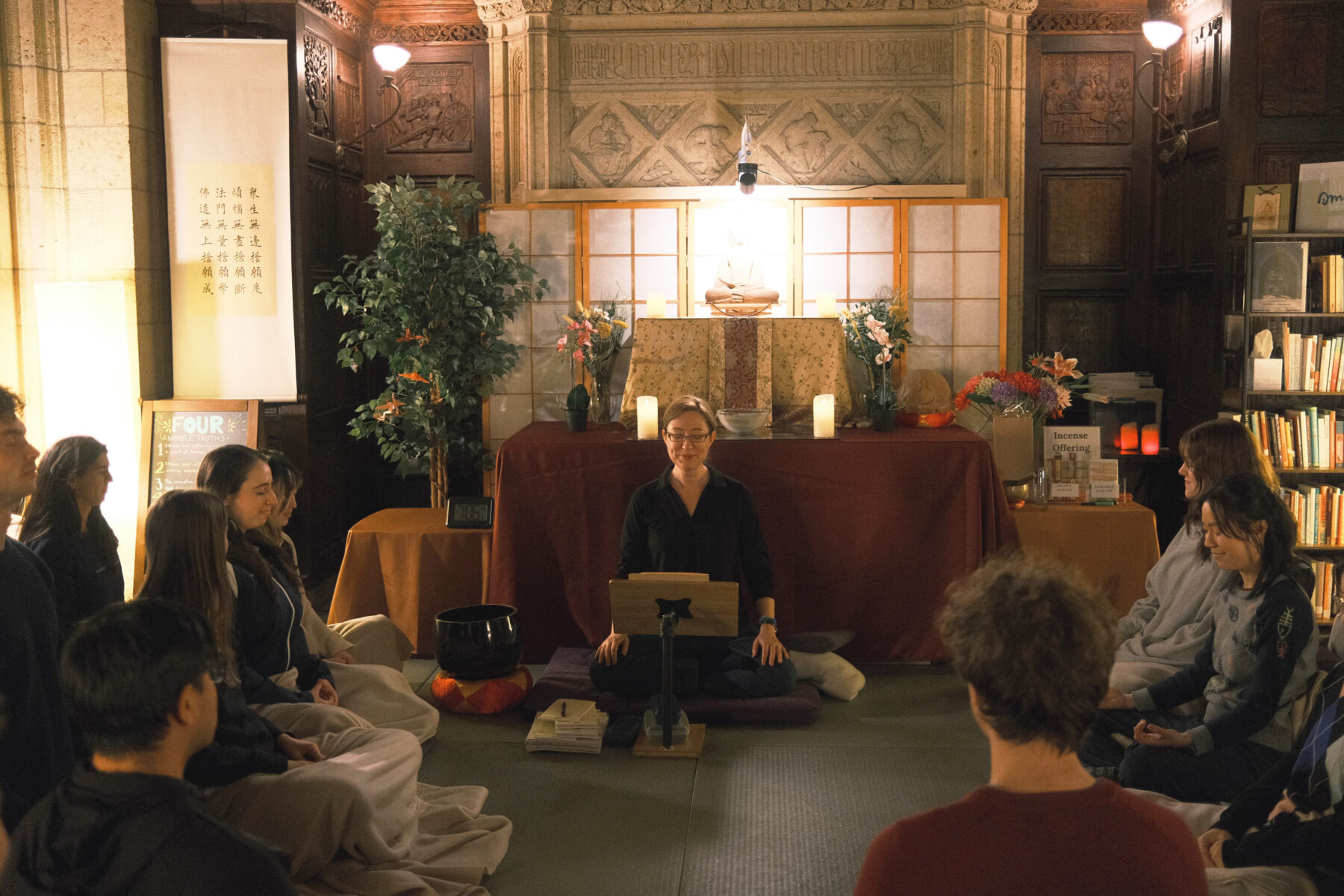
Sumi Kim leading a meditation workshop at the Yale Buddhist Shrine. Photo by Colin Kim.
In 2023, Putt Punyagupta ’23 wrote an opinion article for the Yale Daily News criticizing the shrine for overemphasizing meditation. He argued that the shrine overlooked religious Buddhist practices, such as extensive ritual worship and presenting offerings to the Buddhist clergy Punyagupta, who had been ordained as a Buddhist monk, argued that the shrine’s vague and all-encompassing focus on meditation made Buddhist practice “sacrally vacuous.”
“I no longer practice Buddhism in any meaningful way as I found its upkeep simply impossible without a space to engage in familiar forms of devotionalism,” Punyagupta wrote.
Punyagupta also lamented how student leaders within the Buddhist community publicly identified with other religions. To him, this meant that they had watered-down and cherry-picked certain Buddhist practices, removing them from their “original religious contexts.”
Punyagupta wrote to me, almost three years later, that he didn’t mean to blame the Yale Buddhist Student Community (YBSC) for not “doing enough.” Rather, he wanted to speak about his growing sense of alienation due to a “popular desacralization and secularization” of religious practices, not limited to Buddhism.
I asked Kim about the opinion article. She laughed. It was the “bane of her existence,” she said. She wishes she had a chance to speak with Punyagupta and discuss the shrine’s role on Yale’s campus. To reach the most students possible, Kim concentrates on teaching accessible concepts related to secular life: mindfulness, conflict resolution, lovingkindness. Students seeking more rigorous practice organize additional programming. Each Thursday, for example, a few students meet for a forty-five-minute-long meditation.
She also knows that some students may only practice Buddhist meditation during their years at Yale. Even within those four years, students struggle to make time for the Buddhist shrine. YBSC’s current president, Phoenix Boggs ’26, often forgoes Sunday meditations for senior society or to address “Sunday scaries” of unfinished work, she told me. Even though she puts homework first, “if you were to ask me which I think is more important, it would be” meditation, she said.
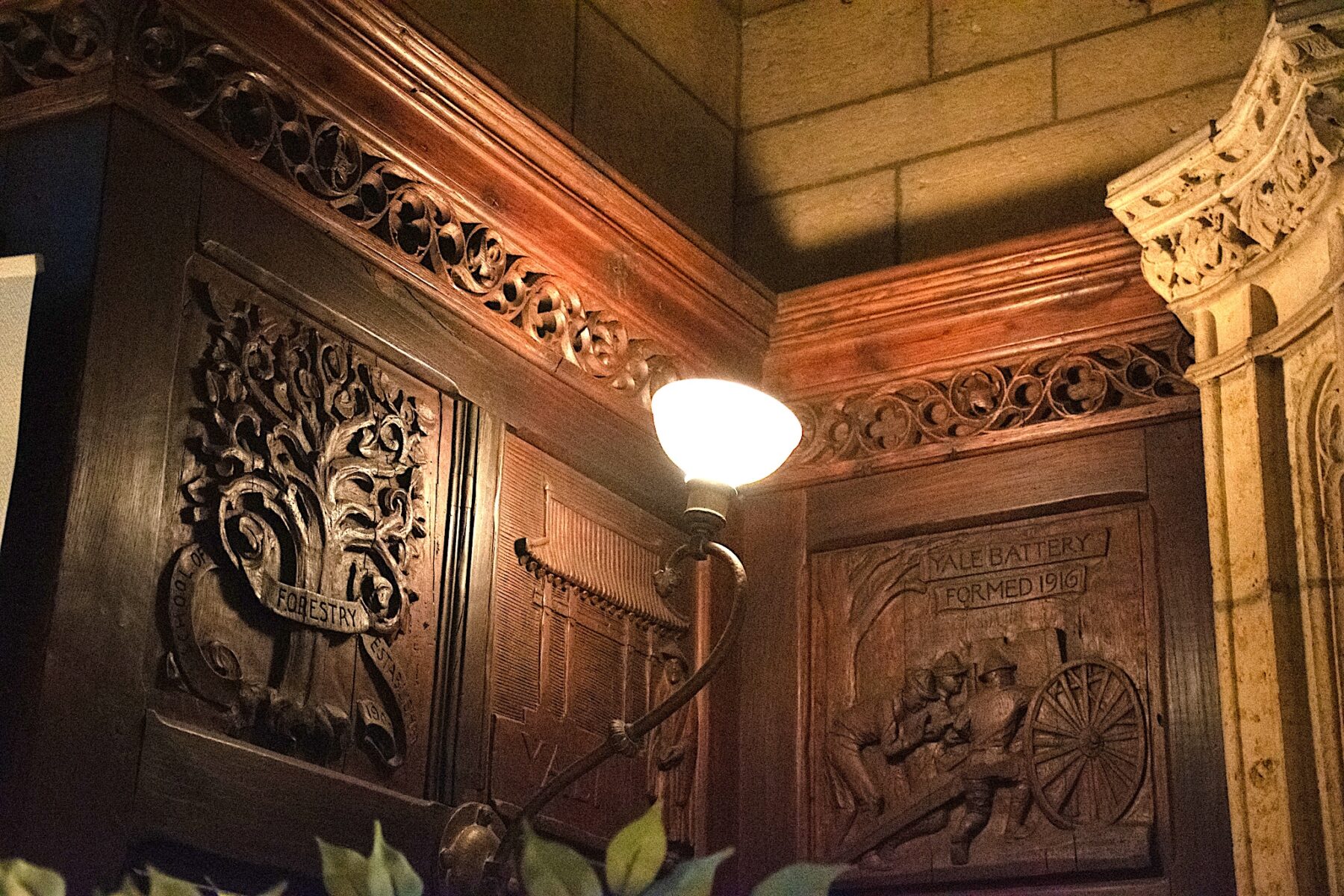
A detail in the Yale Buddhist shrine in the basement of Harkness Tower. Photo by Katerina Matta.
Even when students do make it to the Buddhist shrine on Sundays, some of them struggle to find peace in these meditations. While Buddhism is a spiritual practice, many attendees at the shrine see it as a form of self-improvement.
Tyler Wu ’29 began meditating during the COVID-19 pandemic and has continued his practice at the Buddhist shrine. He saw meditation as a form of self-improvement, not necessarily as a form of spirituality.
“I truly do think that it’ll pay its dividends.”
Wu’s currently creating a startup to limit social media usage. He thinks apps like Instagram make users less mindful. As his time at Yale gets busier, he said meditation helps him stay balanced. His goal is to meditate for 15 minutes a day, even on days when he later goes to the shrine. He sees it as an investment. “I truly do think that it’ll pay its dividends,” he said.
Like Wu, Gus Renzin ’27, the current secretary of the Yale Buddhist Student Community, began meditating in middle school as a form of self-improvement. It wasn’t the “healthiest reason” to start meditating, he told me. It’s easy for a desire to meditate once a day to escalate into a self-improvement regime, he said—similar to the easy toxicity of workout or diet regimes. While these practices could be healthy, practitioners can cling to them for support, the very action that meditation seeks to reform.
Renzin tries not to cling to these practices anymore. Every day, at around seven in the morning, he does mindfulness and metta meditation in the Trumbull courtyard. For twenty minutes, he soaks in the sounds around him, the feeling of his breath, and the movement of leaves in the trees.
When I first visited the shrine in January, we meditated on self-compassion.
Everything was still. Eyes closed, I laid my hands on my lap, sitting up much straighter than normal.
My mind wandered. I wondered how many people in the room were worried that they should be studying. How many were frustrated by the challenge of self-compassion.
Then, my mind drifted to the William Wordsworth inscription at the base of the chimney, dedicated to Harkness: “The best portion of a good man’s life, his little, nameless unremembered acts of kindness and of love.”
In the pauses between Kim’s slow words, my thoughts separated from myself, and I existed outside my head, in the corners of the room and the divots in the ceiling.
Kim rang a gong to signal the end of the meditation. I opened my eyes.∎
Anya Geist is a sophomore in Silliman College.