

Under a loctician’s skilled care, a writer uproots Black history, self-care, and his own hair along the way.
Lyzette Hicks knows Black hair like it’s the law. Wigs used to be “forbidden,” she says, but now plenty of women are wearing wigs. Lots of kids are wearing bonnets or do-rags outside the house, she says, and they should “throw a hat on.” She says she’s concerned about how ski masks are trending, and how they make every Black boy look the same. She says if you’re a guy above 30, you shouldn’t get cornrows. “They’re immature,” she says. She says lots of women do knotless box braids and you “can’t go wrong with them,” but she says that like she’s bored. She says some women do boho bob styles and “those ones are cute,” and she says that like she really means it. “Locs are huge.” She said that twice. “Locs are huge.” I know very little about my hair, so I go with what she says.
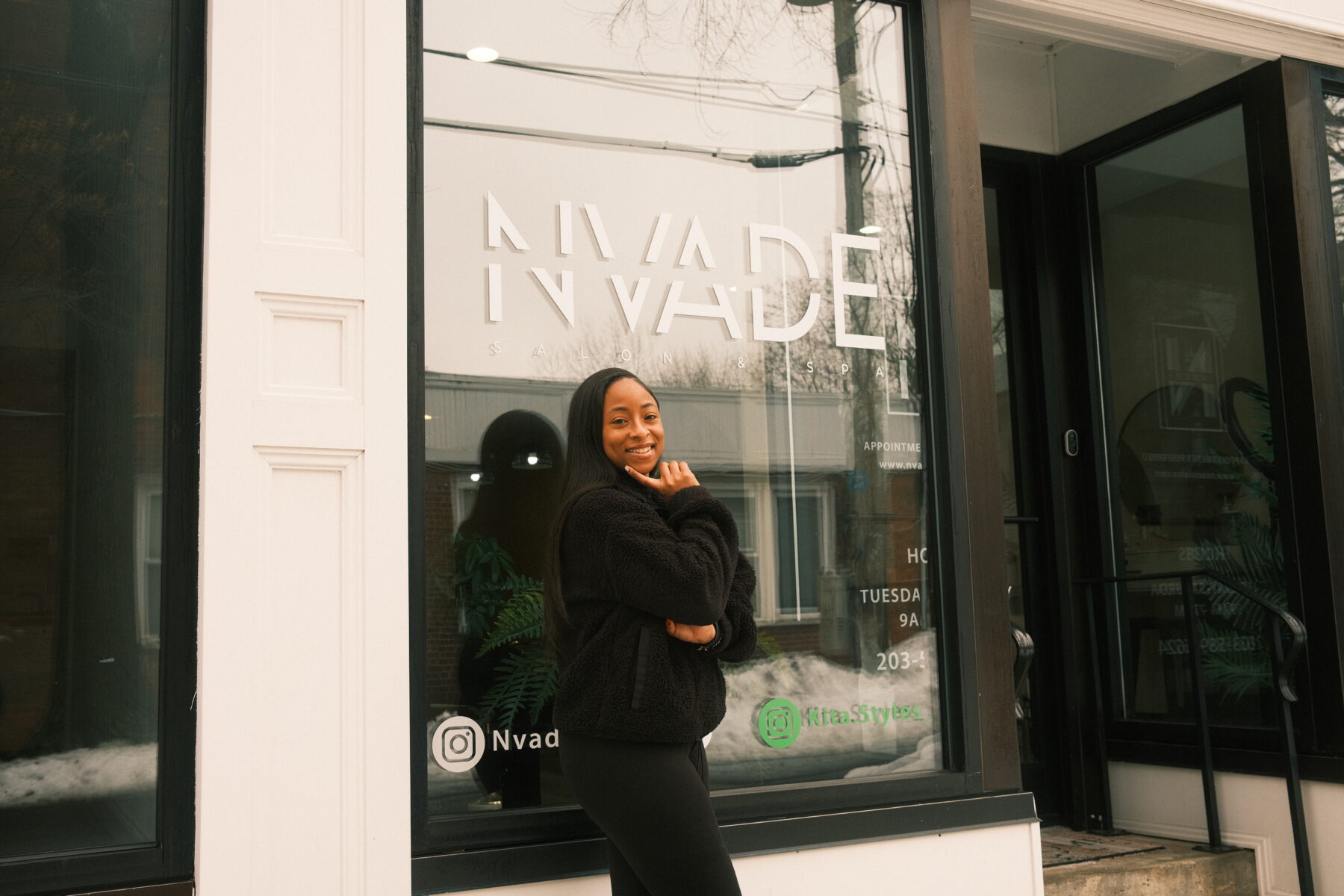
I asked Lyzette what she thought about a recent court decision: In 2023, high school administrators in Mont Belvieu, Texas, suspended a Black student for months because of his locs, and the judge ruled in favor of the school. Lyzette said “hair is hair.” As the owner and head stylist of Nvade Salon and Spa, Lyzette, age 35, could run her corner of Whalley Avenue like a courtroom, bang her comb like a gavel, and make clients live by her hair law. But when clients bring in requests, Lyzette doesn’t judge. She gives them her honest opinion and then gives them what they want. If you’re like me, and don’t know what you want, she might steer you toward locs.
Tuesdays and Wednesdays from 9 a.m. to 3 p.m. and Thursdays through Saturdays from 9 a.m. to 12 p.m., she stands perfectly-postured behind the salon chair, while her eyes split focus between her client’s scalp and the TV screen. Between clients, she rests (ever so briefly) on her leather chair and brushes her own jet-black shoulder-length silk press. Between comb strokes, she wipes gel off her hands. She’s more professional than the characters on Lincoln Lawyer, her entertainment of choice, even if her uniform is sweatpants and t-shirts. When a hair follicle objects, she furrows her brow or narrows her gaze, but this is rare: the hairs know better than to disagree.
I wouldn’t want my lawyer watching Netflix in the courtroom, but based on how much she was looking up at Lincoln Lawyer, I’m confident that Lyzette can style hair without looking.
* * * * *
Lyzette says doing hair is an art. It’s not painting sculptures or landscapes or soup cans. To her the art is making clients feel good when they leave her chair.
According to Lyzette, women don’t feel like themselves when their hair isn’t done (maybe that’s why she makes time for intermittent self-grooming). Clients with renewed ‘dos feel like dolls fresh out the plastic—brand new.
Lyzette and her two stylists do braids, silk presses, twist outs, wigs, weaves, and her personal favorite: dredlocs.
To create locs, your loctician (loc+beautician, but really more like loc+magician) uses her comb (wand) to bewitch the hair into dozens of tiny sections. She then commands each set of strands to stretch, bind, and intertwine. Afterward, to grow your freshly twisted coils into locs, you must keep them clean, hydrated, dust-free, and wrapped in a do-rag while you sleep. After keeping the routine up for four to five weeks, you revisit the loctician (now think loc+physician) to make a diagnosis, prescribe new products, and retwist the hair.
Unlike her clients, and more like balding men, Lyzette wears a lot of hats: she’s a licensed cosmetologist, a salon owner, a caregiver for adults with intellectual disabilities, a psychology student at Gateway Community College with a certificate in drug and alcohol rehabilitation, and a single mother. Someday Lyzette hopes to run a support group for women—“a safe, consistent space where we can show up, release, grow, and connect”—but for now she just life-coaches from her styling station. She doesn’t want to stay behind the chair forever. (As soon as Lyzette admitted this, her client went, “Woah, woah, woah. Woah,” as if his favorite character just got cut from a series.)
* * * * *
After twenty-one years, I’ve concluded that my afro is dry. If it were a person, it couldn’t hold a conversation. If it were a planet, it couldn’t support life. I constantly touch my hair, treating the spot above my left temple like a toy. I fiddle with the arid hairs so routinely, you’d think a tiny Bop It! guy was on my shoulder telling me to Twist It!
The game was always interwoven with academics. When I was younger, wrapping my head around Biology, I held my homework in one hand and with the other I grabbed two fingers full of follicles to Crinkle It! Roll It! Press It! against my head so that I could better Grip It! then Twist It! some more. Today I play the same game in every Yale library under the sun. (It’s like a Dave & Busters, but instead of 40-year-old sweaty gamers, you’re shoulder to shoulder with somehow sweatier, GPA-obsessed twenty-somethings.)
You know how a tree stump’s rings tell you the age of a tree? The number of twists on my head tells you 1) how long I’ve been studying in the library and 2) how stumped I am on any given night. evenings become mornings—I uproot every pine-shaped hair using my pointer finger as a plow. Then, with the cold metal prongs of a pick, I comb the disconnected curls until they assimilate with the rest of my head.
During this gruesome process, the fallen 4C soldiers fly off my head and parachute onto my shoulders. There are so many hairs that—especially if I’m wearing white—it sort of looks like a three-dimensional Rorschach test. Afterward, I ponder my mortality and think, “Did I really pluck out that many dead hairs, or is this semester so difficult that I’ve started balding?”
When my dad was my age, he had cornrows. Now his scalp is brighter than my future. One day, I may be forced to trade in hairstyles for hats. I went to Lyzette because I needed to do something new with my hair—while it’s still growing, before I grow up.
***
When Lyzette was a kid living in Brooklyn, her hair was safe in the hands of family friends, and the lead stylist was her mother. Her mom, who worked as a nurse, was good enough to have been a full-time stylist but settled for being Lyzette’s part-time styling tutor. She gave 9-year-old Lyzette all the ‘90s styles—bantu knots, ponytails, cornbraids— and Lyzette studied them, practicing on herself and her siblings as homework.
When Lyzette was 12, her mother dropped her off at an African braiding spot on Church Avenue to get braids. This is where Lyzette started shadowing the full-timers. She loved the cramped space, its red walls smattered with photos of braiding styles; the rich smell of incense and oils; the dialogue of African movies on the tiny TV. She took mental notes on the neat patterns that the braiders used, even though their braids were tight enough to make her head hurt.
“I used to watch ‘em and be like, ‘Oooh O.K., now I’ma do this,’” she said. “Mannn, it was over after that.” She became something of a mad scientist, conducting experiments that used hair extensions instead of test tubes. She tried to singe the ends of the hair extensions like her braider did (so the extensions could better seal onto the hair), and she still has a burn mark on her hand to prove it.
By 16, Lyzette got her hands off the lighters and onto people’s heads. She got into cosmetology classes outside of school. She got to work as a salon assistant in Flatbush. In Toya’s salon, a shoebox-sized room with three chairs, Lyzette got to care for strangers’ hair. She got to split her profits with Toya fifty-fifty, unlike most starter stylists who split with salon owners forty-sixty. She got to dream about her own spacious salon, where she’d collect the whole hundred.
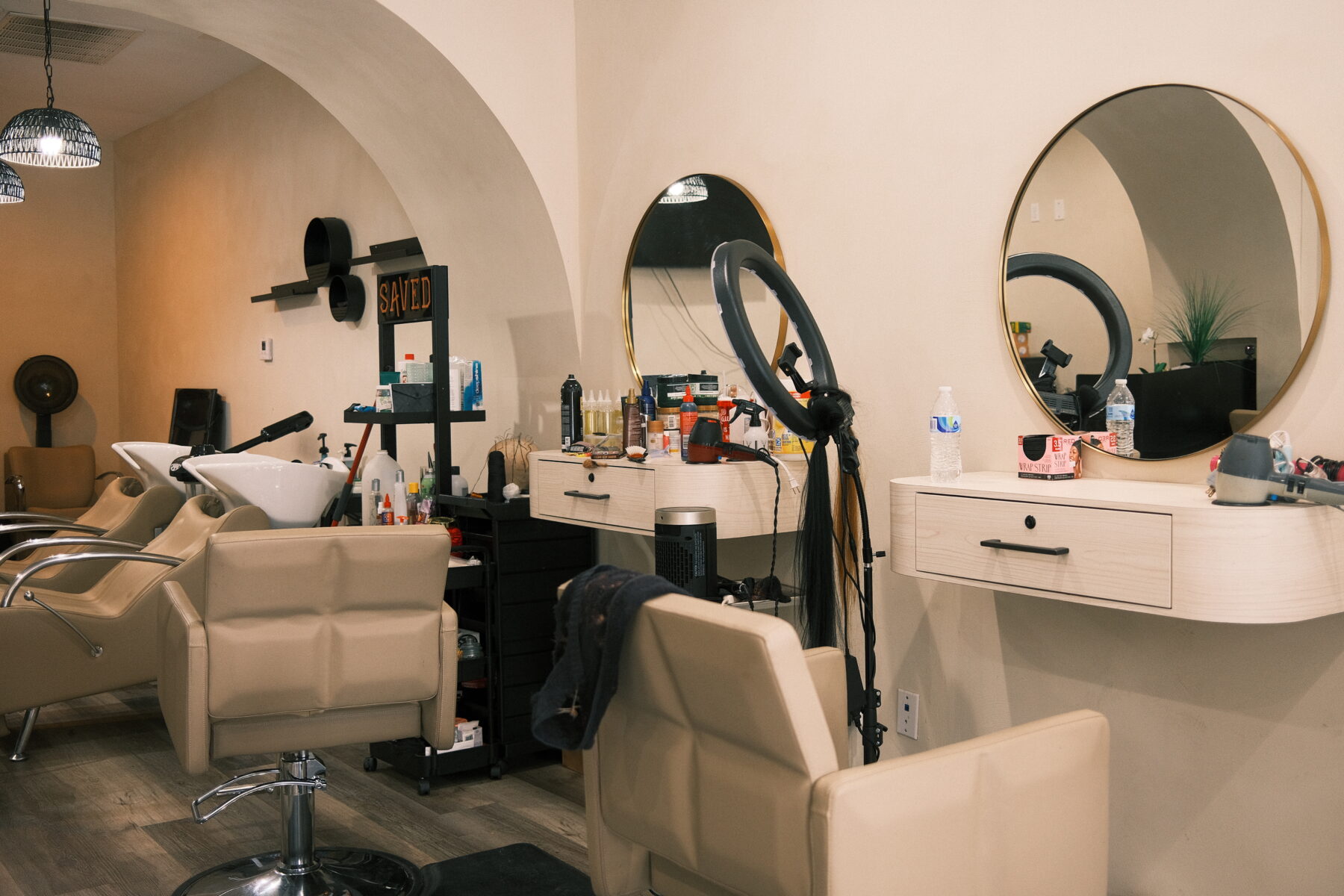
Her first self-owned salon was She Bad Hair Studios. “When I think about the name, I just like— yeah, I grew up from that,” she said, also using the words “spunky,” “fun,” and “girly girl” to describe its aesthetics. She specifically said that she wouldn’t use the phrase “hot girl” to describe its bright pinks and green grass wall. When She Bad closed down in July of 2023, she bounced back with Nvade Salon and Spa. Her new adjectives: “calming,” “relaxing,” “zenful,” “sacred.” The new color palette is mostly a soothing soft brown (on the floor, chairs, and walls), with hints of white (on the sinks and styling stations), and gold (most noticeably glowing from the neon sign spelling NVADE). The new space feels millennial but not spiritless.
***
In 15th-century West African civilizations, hair stylists were usually the most trusted members of society. That sounds like hyperbole, but back then someone’s hair told you everything about them: age, ethnicity, religion, wealth, marital status. Your stylist basically used a wooden comb and palm oil to write your dating profile. For the Mende people, offering to style someone’s hair was an invitation of friendship. Hair styling sessions were social hours. Hair appointments were about more than time or money—your reputation hung in the balance of someone else’s hands. Adorning someone’s hair was the highest honor. In his 1734 memoir, West African nobleman Ayuba Suleiman Diallo called having his hair shaved by enslavers “the highest Indignity.”
Dr. Mathelinda Nabugodi, in her essay “Afro Hair in the Time of Slavery,” wrote: “In preparation for the slave-ship hold, captured Africans had their hair shaved off: while the immediate motive was hygiene, the act of shaving anticipated the social passage across the Atlantic.”
British colonists intentionally used African hair to liken enslaved people to chattel. “The planters do not want to be told, that their Negroes are human creatures,” said Edward Long in his 1774 The History of Jamaica. He called the hair “a covering of wool, like the bestial fleece.”
For the first African Americans, proximity to the colonies meant distance from the tools, traditions, and culture that upheld their humanity and their majesty. To regain it, they created new tools, new traditions, and new culture. A new country meant new crowns.
In the early 1900s, Black masses were escaping the violent South and migrating to Northern cities. In these urban areas, white entrepreneurs realized the value in Black hair products, but failed miserably at selling them. Black folks didn’t want hot combs from the same people burning down their towns. They wanted their heads in safe hands.
The safest, most reputable, and eventually most wealthy hands belonged to Black women like Madam CJ Walker. She knew the troubles on Black people’s minds (or heads) and most importantly, she knew how to serve them. One solution: straighten that hair. Walker sold your typical products—hot combs, hair growth products—and demonstrated how to use them, attaching self-portraits to her advertisements. And that sister taught her employees the sales strategy like it was gospel. In a letter to her agents, she wrote: “Keep in mind that you have something that the person standing before you really needs. Imagine yourself a missionary and convert him.”
At this time, beauty standards encouraged Black people to opt for straight hair over curls. Walker didn’t set the trend. But she made the trend accessible, and sold it from trustworthy hands. In her lifetime, Walker donated thousands of dollars in sales to organizations such as the National Association for the Advancement of Colored People, and she wasn’t shy about it. She let twentieth century Black people know that haircare was an investment in the longevity of the race.
Nearly a century later, in Lyzette’s salon, blow dryers whir, water splashes, and clients take calls. The Lincoln Lawyer theme blares, Lyzette asks a question about the show, she remembers a story, her eyes flick around the room, she gets excited, her hands start to dance, hair gets washed, extensions get snipped, weaves get glued, blowouts get blown out, braids get braided, locs get loc’d. You can feel the spirit every day other than Sunday and Monday.
* * * * *
Lyzette is still while she gives her client a retwist—the process of tidying part lines and incorporating new hair growth into existing dredlocs. The only movement happens from her elbows to her fingertips. Her forearms leverage the headrest, her wrists rotate at lightning speed, and her fingers pass through the hairs with the delicacy and precision of sutures. You can see her hand’s muscles at work, even without X-ray vision.
I asked Lyzette what the most difficult thing about doing hair was. Without skipping a beat, she said, “the clients.”
Startled, I started laughing, but her eyes were pitch black. Dead serious.
“I’m big on energy, and some people’s energy be off. And you could kinda feel it,” she said. Hardly a moment passed before she corrected herself: “Well, I could feel it.”
For two to three hours at a time, Lyzette studies and serves her clients because their satisfaction is the key to getting compensated. Once she’s worked with someone “on the regular,” Lyzette can tell “if they’re having a good day, if they’re having a bad day.”
She’s even learned to attach energy to style. Silk presses and weaves are indecisive. Dredlocs are quicker to schedule follow-ups.
Leading up to my first meeting with Lyzette, my haircare and self-care (or lack thereof) posed greater medical challenges than Male Pattern Baldness. The nebulous concept of “energy” makes more sense to me than the words vasovagal syncope, sinus tachycardia, and postural orthostatic tachycardia syndrome (also known as POTS). But these are the words I heard in the days before meeting Lyzette. One night last fall, after a week of late nights and stress twists, I fainted for the first time in my life (a vasovagal syncope), and landed directly on my face. Immediately, I was sent to an emergency room (busier than even the most popular hair salons) to get a few stitches, run a CT scan, conduct heart tests, and do a bit of dental work. When I fell, two of my teeth chipped, and one popped out of my mouth like an Airpod out of a dropped case.
A cardiologist later told me that I was “basically a poster child” for POTS, the syndrome that caused my fainting. As it turns out, skipping meals and barely drinking water—all in the service of a better GPA—are common precursors for passing out. It’s less common to break three of your front teeth, which actually makes you look more like a poster child for the tooth fairy.
The night of my injury, a student doctor placed the tooth back into my mouth, stuffed some gauze under it, and told me to bite down until the tooth was snug in my gums. It fit about as comfortably as a butter knife fits in a power outlet.
I would soon learn that I was actually pretty healthy. More sleep, more exercise, better diet, and more hydration would lower my chances of fainting again. It also meant retiring from all-nighters, no matter how long an essay might take. Restoring my smile would take one and a half years. Over that period of time, I’d get acquainted with esthetic dentists, dentist dentists, and an ER dental student. I’d introduce a number of phalanges and oral ephemera—a metal brace, bridges, Invisalign, root canals posts, and crowns—to my mouth. As it turns out, restoring your pearly whites is a delicate process, as cosmetic as it is medical.
But for the time being, I was dealing with a combination of health insecurity and cosmetic insecurity. In the mirror, I saw not only a sleep-deprived college student, but a smile with enough holes to give you trypophobia.
The only other time I’d undergone such an instant transformation was in the summer of 2020, the week my afro went on hiatus. During Covid, other stir-crazy souls opted for bangs, big chops, and dye jobs. I was itching to twist my hair. I’d wanted to twist it for years, and maybe I finally felt comfortable doing so because I was spending more time at home and less time out and about in Forest, Virginia. My hometown’s demographics range from rural to suburban, moderate to conservative, and white to whiter. When I was at school, I was mainly seeing straight-haired folks, and I’m not talking silk presses. I’m talking about the Your hair looks so soft, can I feel it? folks. When Covid kept me out of the petting zoo, I let my mom try taming my mane.
In my camera roll, there’s a picture of 15-year-old me, right after my mom twisted my hair. Short frizzy coils sprout from my head in every direction. There’s a somewhat indecipherable look on my baby face. There’s a mix of shock and fear, like I’m taking a mug shot for stealing out of the cookie jar, but I was falsely accused. I remember the thrill of my new hairstyle, but also the assortment of fears: that my friends would see it and say something distasteful, that I didn’t like it as much as my stylist (my mom) wanted me to, that I looked too much like the people—my people—being policed in the news. That I didn’t look like me. That I looked too much like me—a new, exciting, scary me.
In my camera roll, there’s another photo of me taken a week later. I look just as young. I’m at a food bank holding a bundle of apples. I’m wearing a black cloth mask, but the joy on my face is unmistakable. The hairstyle looked a bit more natural than it did immediately post-living-room appointment. Maybe liking your appearance, having faith in your hairstylist, or being confident in your culture is like enjoying a new hairdo: you grow into it over time.
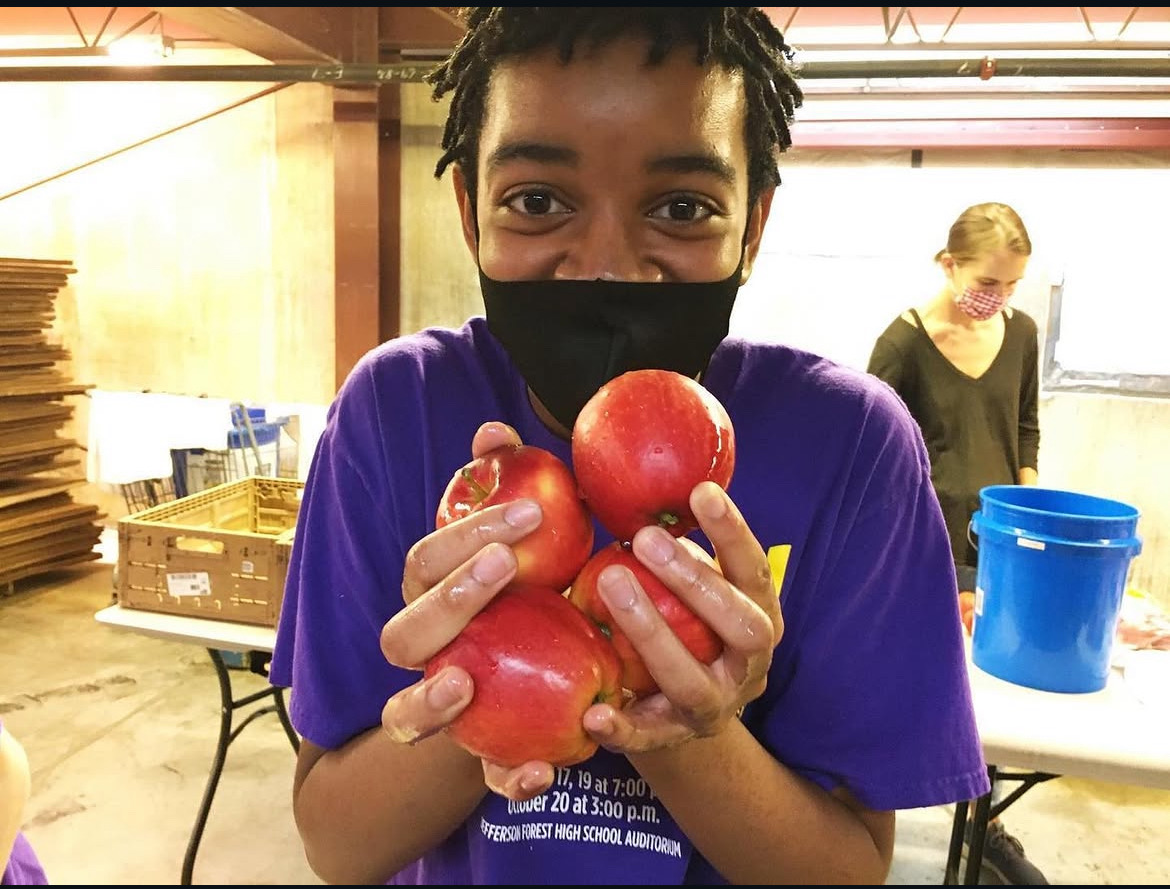
The writer, aged fifteen.
* * * * *
If Lyzette is right, every style makes a statement. I wanted my hair to talk like me, not one of the Black Republicans from that Key & Peele sketch. (They all wear glasses like mine and insist they’re not a monolith.) I wanted my hair to grow closer to my culture. I don’t want the hair of a conservative with weird kinks (à la Clarence Thomas, probably), I want the coily, kinky hair of a liberated artist (à la Basquiat).
At college, I didn’t have to leave my school district to see do-rags and box braids. I could just leave my bedroom and bump into my housemates. And when I told my housemate that I decided to get my hair twisted, she said, “Ooouu that’s so Black.” And I didn’t disagree.
I wonder if Lyzette analyzed my energy when I entered on Thursday morning. I don’t know if she could tell that I was more exhausted than usual; that I pulled another all-nighter catching up on classes; that I’d missed classes because of the medical appointments; that teeth #8, #9, and #10 were under repair.
If she did notice, she didn’t mention it. She could, however, tell that my hair was “definitely on the drier side.”
I reclined into the chair—about forty-five degrees from the ground. I placed my neck against the U-shaped slot on the edge of the sink’s basin. I could’ve fallen asleep, but then I heard the waves crash.
Lyzette held a detachable nozzle in one hand and tsunamied every last strand. The jet washed over my cuticles, removing the surface-level debris.
Then she put her hands in claw formation and filled them with clarifying shampoo. It has surfactants, like many animal-tested, dirt-destroying cleaning products. Lyzette explained that it basically does to your hair what bleach does to white clothes.
Too much clarifying shampoo risks depleting your hair’s natural oils, so Lyzette followed it up with two additional batches of goop: an almond butter shampoo to trap those natural oils in place, and a conditioner to beef up the shinier, stretchier follicles so they wouldn’t break.
Finally, Lyzette showered the hair with a cascade of cold water. My hydrated hair slunk into the sink.
After the wash, Lyzette walked me over to the salon chair and pumped it up until my shiny, stretchy curls were at eye-level (about five feet high). Then she pulled a little black comb from the back of her head. She dolloped a blob of translucent gel onto her gel band—a heart-shaped silver plate with a pink strap—wrapped around her wrist. Lyzette’s methods involved no tugging, no pulling, and no pain.
In the mirror, I saw her technique: she combed out the hairs selected for coiling, latched onto the roots, and rotated the comb like a screwdriver. She coiled meticulously from kitchen to crown. For every coil, her hands moved from comb to gel to hair— brush to palette to canvas.
Mona Lisa couldn’t have been more comfortable than I was, and I doubt she kikied with da Vinci.
* * * * *
During the appointment, I told Lyzette about my all-nighter, my work, my appointments, and my fall because 1) your doctor should know your full medical history and 2) because my loc doctor is kind. She offered me a bottle of water, then wisdom.
“Your hair is like a plant,” she told me. It requires hydration, sunlight, and maintenance. When I left the salon, I went with what she said.
Over the next four weeks, I watched my twists sprout and grow. I sprayed them under Lyzette’s instruction. I hydrated myself and my hair. During the day, I let my hair flail in the wind. At night, I wrapped my do-rag like a bedtime prayer. I prayed for hydration and renewed confidence. I prayed for new teeth. I prayed for new habits and new growth. ∎
Prentiss Patrick-Carter is a senior in Grace Hopper college.
Photos by Colin Kim.