

Class Colors
The morning I snuck into Tamar Gendler’s office hours to ask about CourseTable, the Yale class cataloging website, I found myself in the company of one Directed Studies student, two members of her seminar, “Intelligence: Human, Animal, Artificial,” and books of all colors.
This spring was the first semester in twelve years that Gendler taught undergraduate courses full-time. She’s returned to a Yale in which CourseTable, the student-designed website that compiles information from all course evaluations, has taken over what was once known to undergraduates as “shopping period,” now known as add-drop. CourseTable has made choosing one’s courses feel like the click-and-choose process of actual online shopping.
I asked Gendler what professors think about CourseTable’s ubiquity among students. Do her colleagues even know about it? “I think everybody knows about CourseTable,” she said, laughing, incredulous at my astonishment.
I asked Gendler what she thought about CourseTable’s color-coding: classes that students had evaluated as requiring less time and effort are coded green, progressing through yellow and orange to red, the most rigorous. Are green, yellow, and red designed to function like universal traffic-signal colors? Does CourseTable so openly encourage students to take courses considered “easy,” green meaning go? Red as “stop” may be too simplistic a definition. After all, Alex Schapiro, the senior Computer Science major who ran CourseTable last year, said that red doesn’t necessarily mean “worse,” but rather “more intense.”
Gendler said that we often “overvalue” the implications of color distinctions. She suggests that course evaluations might be differently conveyed, saying she “would much prefer it if it were five shades of green, ranging from dark to light, or red, ranging from dark to light.”
Gendler’s “Intelligence” seminar is brand-new, so its workload rating on CourseTable is blank, colorless. I wonder, however, if the deep red of her sweater might provide some clue as to its workload.
—Tai Caputo is a first-year in Benjamin Franklin College.
Bolus Movements
It’s March 22, 3:57 A.M.The Atlanta airport line has passed the IHOP and is starting to double back on itself. Travelers chat in place. A young man with a beehive of a beard explains the Plane-Train to two older ladies with handbags. Children plop down on the floor while a father squats on his bag in front of the promotional Kia Telluride. Some have been waiting for hours. It has been 37 days since the United States government paid TSA employees. “I want two lines, please now folks. Two lines…” I am probably going to miss another flight.
My first flight, to Tweed-New Haven Regional Airport, took off yesterday, presumably empty, as security lines across the country swelled. A friend traveling with me stayed ten hours at the terminal to catch the next available flight to “anywhere-in-train-distance-to-Yale.” I bailed and returned early this morning, hoping to beat the lines. I have class tomorrow.
On the “ATL Airport TSA Wait Times Megathread” on Reddit, one user describes the lines as “stagnant” with occasional “bolus-movements”—the official term for the process that carries food or saliva from the mouth to the stomach. Reported wait times vary between four and eight hours. It is on Reddit that I learned about a lucky few who slipped through the international terminal before the trick got out, and lines there swelled. User traffic on the thread itself is so great that protocols have been put in place. Posts must be labeled “Updates, “Reports,” or “Questions.”
It is conventional wisdom that in times like these, people take care of each other. Victims of natural disasters have been known to help rebuild the homes of their neighbors. Compassion rises.
In the airport security line, compassion gives way at times to fierce competition. A woman behind me stops an agent to point out a couple that has cut the line. My neighbor notes with an edge that the other line is moving faster.
We inch forward.
In the Reddit comments, someone asks if Immigration and Customs Enforcement agents have arrived, and a predictable political argument breaks out. I only spot them once I’m nearly through the line, armed agents standing behind a glass wall.
My mouth is dry. In foolish preparation for security, I emptied my water bottle two hours ago, and now I am thirsty, unable to swallow. As we move towards the machines, I feel we are being swallowed by America.
—Asher Lytton is a sophomore in Silliman College.
The Opposite of Loss
Frog: And Other Essays, the new book by noted Yale writer and professor Anne Fadiman, contains seven essays on widely varied topics, but loss simmers underneath each. Her ode to a beloved printer becomes a meditation on her experience of aging. Her grammarian’s struggle with the singular “they” is also a reckoning with the perceived loss of grammatical standards. Like salt in good cooking, loss in Frogelevates every story to profundity.
The final essay, “Yes to Everything,” confronts the theme head-on. Marina Keegan, a brilliant writer and student of Fadiman’s, graduated from Yale on May 21, 2012. Five days later, her car crashed on her way to Cape Cod. She was 22 when she died, leaving behind a trove of writing which Fadiman, alongside Keegan’s family, assembled into a collection called The Opposite of Loneliness: Essays and Stories.
The essay tonally avoids melancholy by focusing on Keegan’s righteous love of life. In their first interaction, Keegan wrote to Fadiman and identified herself, only semi-ironically, as someone “hoping to stop the death of literature.” In her junior year, after finding herself rejected from Yale’s secret society system, she wrote to Fadiman: “I’ve vowed to spend 12 hours a week writing,” Keegan said, “If I was willing to devote that much time to chatting in a tomb I should be willing to devote it to writing!”
I cried when I read “Yes to Everything.” Much of Frog revolves around death, but on finishing this essay, I found myself less afraid of the End. I felt far more adamant that I should meet the time before it with vigor.
—Will Sussbauer is a junior in Jonathan Edwards College.
Commons of Yore
It used to be the place to be seen.
Walk in and you were met with a smorgasbord of the Yale community—first-year friend groups bound to splinter by Halloweekend, hordes of athletes in knee-length parkas scarfing down Pasta e Basta. Sometimes, you could even spot Dean Pericles Lewis staring eye-to-eye at rotisserie chickens glistening on their spits.
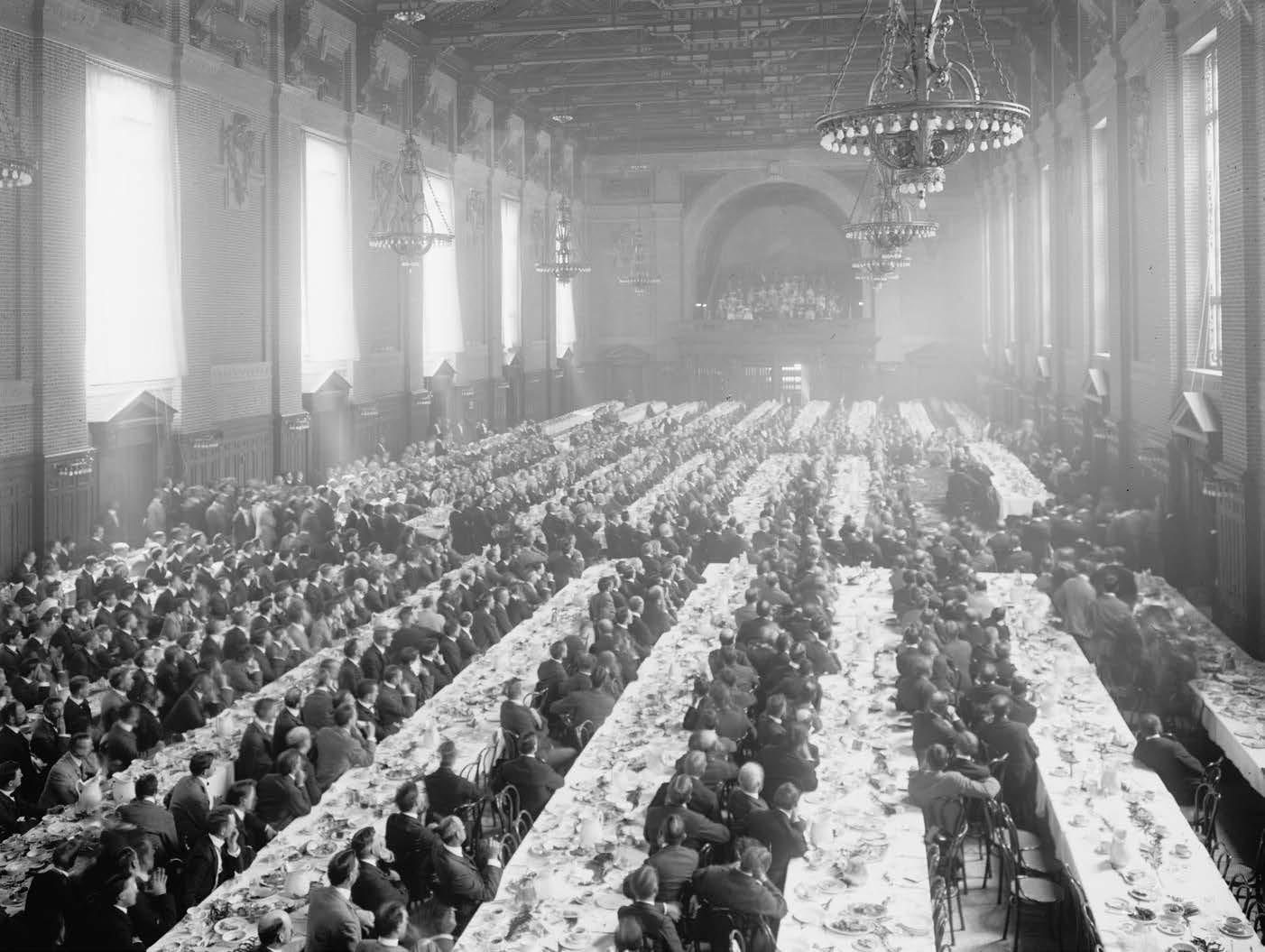
Commons has long been a hallmark of the weekday social scene at Yale. But since the university limited meal swipes to residential dining halls last fall, forcing students to use points, the crowd has shriveled. The high center tables, once in demand, now seat a smattering of Directed Studies students hunched over Kant and Korean fried chicken. Only a few shameful stragglers trickle through the center aisle.
Yale’s tradition of communal dining dates back to 1718, when “Yale College” opened near what is now Bingham Hall, as the first ever combined dormitory and dining facility. Commons has had a tumultuous history. In 1828, student protesters waged the infamous “Bread and Butter Rebellion,” a campaign for improved food quality—many went on strike, refused to eat on campus, and were eventually told to return or face expulsion. In the 1900s, food fights erupted, and service declined as students failed to consistently tip waiters. Administrators enforced strict expectations of etiquette, requiring jackets, ties, and assigned seating. Then, in 1969, Yale dropped these regulations after admitting women to the college, and a new wave of complaints followed.
The idea of waiters serving up clementines and Rooted bowls to diners in their Monday best may seem absurd today, yet students seem to feel a bit of nostalgia for the Commons of yore. Campaigns to vote on meals and pressure on Yale Hospitality to reinstate the meal swipe may indicate an attempt to swing the pendulum back—hopefully, students won’t have to boycott or wage food fights to get what they want now. Updated menu offerings, a new table arrangement, and cookies every day could very well save Commons. As for me, I’ll be taking up shop in the Elm until they bring back the old pesto pasta recipe upstairs.
—Eden Feiler is a junior in Ezra Stiles College.