
New Haven’s bikers want to ride freely, but the city thinks they threaten public safety. Are the two at a standstill?
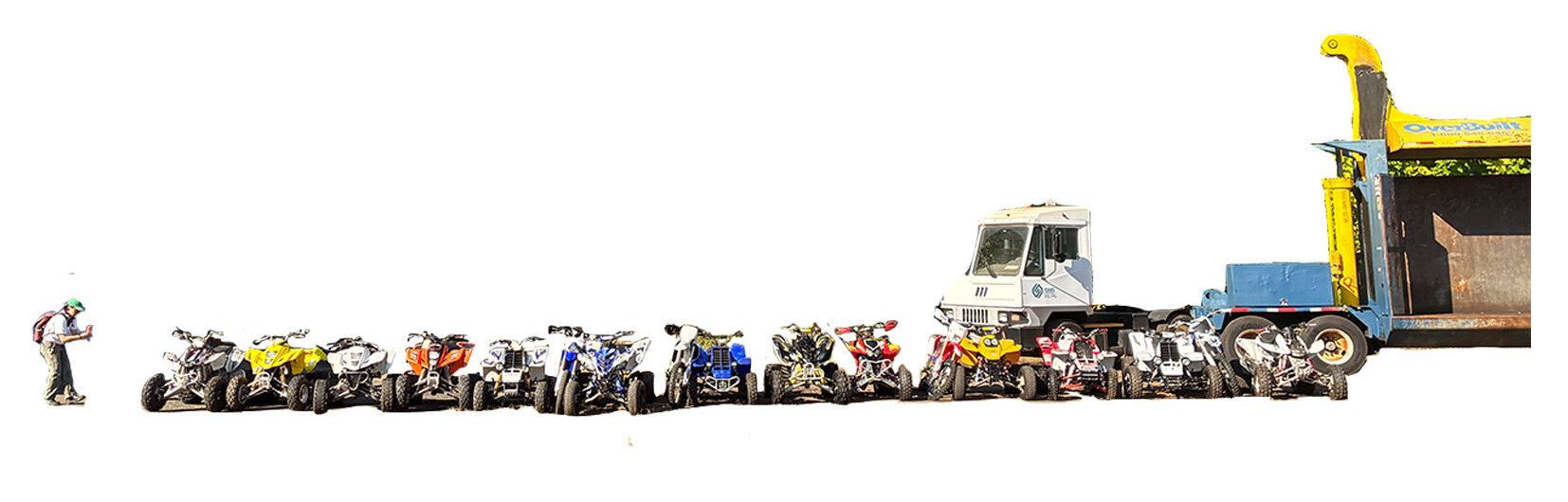
New Haven Mayor Justin Elicker stood before a cluster of ATVs and dirt bikes—and an industrial, high-speed crusher. At 9:30 in the morning on September 19th at the New Haven Police Academy, the City of New Haven lined up eighteen ATVs and dirt bikes in a row. Elicker, wearing a crisp blue button-up, faced his metallic victims. The arm of a crane picked each vehicle up and loaded it into the crusher.
The crushing was a public display of New Haven’s decades-long battle against its bikers. All-terrain vehicles (ATVs) are four-wheelers designed for off-highway use. Dirt bikes are motorcycles designed specifically for rough terrain. Both have been illegal to ride on the street in New Haven since 1971, because the Connecticut General Assembly classifies them as “off-road vehicles.” The city says that the bikers are breaking the law, disrupting traffic, and endangering pedestrians. The thunder of engines wakes sleeping residents, who have taken to town hall meetings to complain. In 2003, Noise Free America, a group that fights against noise pollution, recognized the city as having some of the worst noise pollution in the country. The 2025 law “An Act Concerning Street Takeovers and the Illegal Use of Certain Vehicles,” which ruled it legal to destroy confiscated bikes, made Elicker’s crushing possible.
At the press conference, Elicker described these vehicles as nothing but “dangerous, incredibly dangerous.” But they mean something very different to another set of New Haveners. I spoke to twelve bikers. To them, riding is joy. Riding is power. More than a sport or a pastime, their bikes are a means of self-expression. They, too, grapple with danger: they say they are often chased by police, which contradicts New Haven’s no chase policy. They view their sport as a way of declaring themselves and their freedom, and view the crushing as an example of the city’s intolerance. “You’re taking my property, and you’re giving me no money for it—you stole it,” said biker Teddy Salmond.
Salmond remembers the first time he got on an ATV. He was 7. A construction worker lent his bike to Salmond and let him ride down the trails behind his house. “It was like I had a lot of power,” Salmond said. “Some type of adrenaline ran through my body.”
At the press podium, Elicker was adamant: “If we catch you, we will crush them.” Looking into the cameras lined up in front of him, Elicker pressed a big orange button. The arm of the crusher lowered, and the vehicles’ blue and red and green bodies began to blur together. As the crusher reached the bottom, their hulls were dismembered.
I. A THOUSAND AND ONE SOUNDS OF THE CITY
“One of the most obvious features of Yale,” wrote the Yale Daily News in 1932, “is its noisiness.” The News added that “The thousand and one sounds of the city have been endured as a necessary evil.”
New Haven’s noisiness is not new. And neither is the bikers’. In 1990, another News writer reported how a student stood outside of a first-floor window, blocks of charcoal in hand, “ready to fire at the next noisy biker who drives by.”
Say you walk down Chapel or Elm Street today, especially during the summer or on the weekends. You will surely pass a car, ATV, or motorcycle that someone has modified by removing mufflers and altering exhausts. One resident and former biker told me these modifications can render vehicles so loud that they sound like gunshots. The sounds “add up and slowly eat away our nervous systems,” said Matthew Feiner, a resident and the owner of Devil’s Gear Bike Shop on Chapel Street.
Though ATVs and dirt bikes are legal to purchase, it’s illegal to ride them on public roads. For years, municipalities have attempted to further discourage their use. Since at least 2020, several cities in Connecticut have made it illegal for gas stations to service ATVs and dirt bikes.
Only months after Elicker was elected mayor in 2019, he began a campaign against dirt bikes and ATVs, and in 2020, he oversaw a police operation to arrest nine riders and twelve bikes. The riders were “disrespecting our laws, terrorizing our neighborhoods,” he told NBC Connecticut. In 2021, the city launched a deterrence campaign, raising the fines for those caught riding—once ninety-nine dollars, now 1,000 to 2,000 dollars.
In October 2023, alongside then-Police Chief Karl Jacobson, Elicker created a joint regional task force to “combat illegal dirt bikes and ATVs.” Composed of police officers from New Haven and seven other cities, the task force gathers to share intel and collaborates in seizures and arrests. “The people riding these [vehicles] do not see city limits,” Jacobson said at the press conference announcing the task force. “They just drive and create havoc.” Since 2023, the NHPD has seized at least 120 dirt bikes and ATVs.
Charlotte Anastasio is often jolted awake from a deep sleep at two o’clock in the morning. Beneath her 100 York St. apartment, the thunder of motorcycle engines will rip through the street. All she can do is roll over.
A retired registered nurse who grew up in East Haven, Anastasio, 80, has lived downtown since 2020. She has thin black glasses and a white bob. Anastasio often walks to Atticus Bookstore Cafe to grab a pastry, and she likes to attend Yale lectures that are open to the New Haven community. She loves it here. But the noise is so disruptive that she has considered moving. “It makes me question, is this where I want to live?” she said.
II. SHOOT OR RIDE
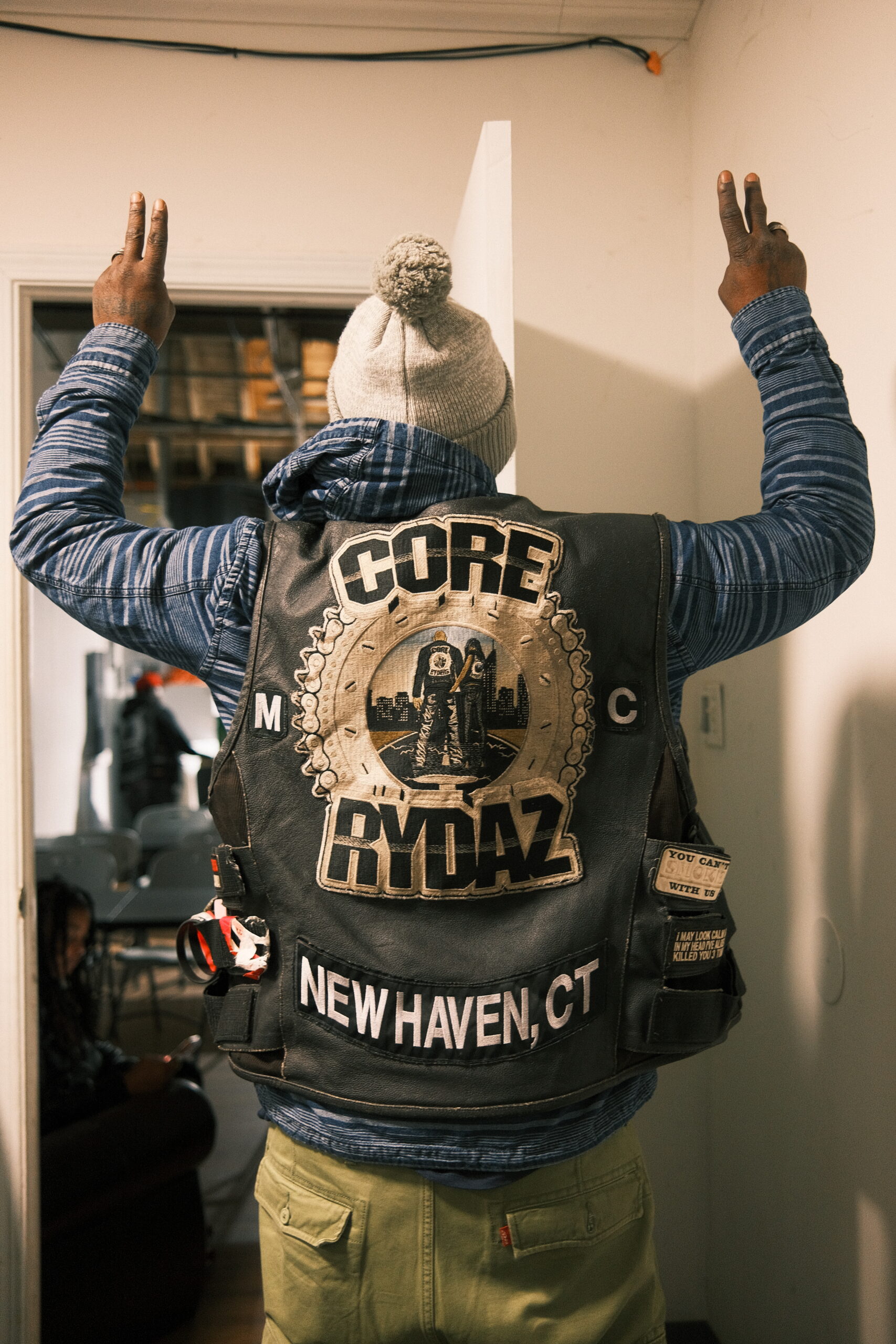
Bobby Bloodworth, whose biker name is Low, is part of the motorcycle club Core Rydaz. Founded in 2009, the club consists of fifteen bikers who ride across Connecticut and the East Coast. When I met them at their headquarters, they were setting up for a night of cards and poker. The kitchen was busy with women who prepared fried chicken and coleslaw stacked on hamburger buns.
To use the language of the biking world, Core Rydaz is a “99-percenters club.” In other words, everything they do is legal. Their vehicles are licensed and insured. Most members are in their 40s or 50s and are married or have kids. Like Bloodworth, many of them fell in love with biking after riding dirt bikes as children.
Framed collages—remnants of game nights and cross-country rides— hang on a wall. Some pictures show girls, surrounded by bikers, in long frilly dresses with tiaras on their heads. The club has done prom escorts for as long as it has been around. They do funeral processions too, but of those there are no pictures.
Bloodworth talks rapidly, as though words are spilling out and he cannot keep up. There is dirt beneath his nails and his hands are rugged and worn. The end of his beard is graying. He seems much older than 43.
Bloodworth grew up traveling with his grandmother. As she drove down the highway, Bloodworth watched dirt bikes behind cars. He’d imagine that he owned the bikes. The blue ones were always his favorite. In the neighborhoods of New Haven, Bloodworth watched similar bikes drive past his house and pop wheelies. “Look,” he would tell himself, “that’s my bike coming down the street.”
When Bloodworth’s grandmother moved down South, he had freedom to play. He bought his first dirt bike at 17. It was unregistered and uninsured. Bloodworth was joyriding everywhere. The streets were his.
At 22, he had a son. He bought a motorcycle—less fun, but safer insofar as he was no longer “being chased on the street while cops were hitting and beating us up.” Five years later, the mother of Bloodworth’s son died. Bloodworth buried her with the help of his grandmother, who gave up her plot for her great-grandson’s mother. After that, riding became a respite from his grief.
It is difficult to talk to a rider without the mention of death: of a friend, a parent, a lover. They rarely name a cause. They talk past it or over it—it’s better to be present, to focus on the living.
Bloodworth walks me through his scars. Faint lines crisscross his knuckles and the sides of his hands. A thick line stretches across his palm. One day, Bloodworth had thrown back a couple of drinks, hopped on a bike, gunned it, and launched himself into a curb. When he got up, he didn’t notice at first that his hand was split open. It took him a month to realize that he had broken his bone.
Unable to use his right hand, Bloodworth lost his jobs at All American Waste and the DACO School Bus Company—his only means of feeding his family at the time.
When he talks about his injury, Bloodworth slows down. His relationship with the bike, like the rest of his life, is complicated. But for “all the time and stress and aggravation” of his loss and his poverty, getting on his bike still makes everything disappear. “It’s relief,” he said.
Biking clubs such as Core Rydaz act as safety nets. If the rent is late, if you can’t pick up your kid from school on time, if there isn’t food on the table, another member will help. Bloodworth keeps an extra can of gas on him, just in case someone runs out. In 2011 Core Rydaz raised funds for a young boy, hospitalized for cancer, who dreamed of owning a bike.
In New Haven, the bikers say, there is a choice: shoot or ride. Terrance Smith, a biker who describes himself as being from the inner-city of New Haven, used to ride with people affiliated with certain gangs in New Haven. One such biker told Smith about encountering a member of a rival gang. “Listen,” the biker had said, “we from different neighborhoods, but every Sunday, I ride with him. And because I ride with him, me and him are the best of friends.”
More often than not, though, it is strangers who ride together. Street takeovers are usually unplanned. It begins with one rider, who might sync up with another, and then another. The group of ten to forty bikers will ride together down the street, taking up the entire road, ripping through red lights and blocking traffic from passing. It is part of the thrill to not know who is next to you, but to know that you are together, connected by the thunder of your engines. To know for that moment, the street is yours.
III. WHOSE SAFETY?
In 2022, 35-year-old Sueann Lamazon was waiting to enter the crosswalk when a dirt biker popping a wheelie hit her. Lamazon was hospitalized with multiple broken bones and internal bleeding in her head.
Just before crushing the confiscated dirt bikes and ATVs, Elicker looked up at the camera and said, “This is the one time when I talk about ATVs and dirt bikes when you’re gonna see a smile on my face.”
Elicker believes that bikers threaten the community’s safety—riding recklessly and disobeying traffic laws. Occasionally, he adds, dirt bike and ATV riders also possess guns illegally and are part of gangs. It creates an environment where residents feel unsafe. “Sometimes they’ll stop in an area and drive around cars and taunt drivers,” Elicker told me over the phone.
At the public crushing, former New Haven Chief of Police Karl Jacobson told the press that ATVs and dirt bikes were extremely difficult to police. Both Jacobson and Elicker cite what they call New Haven’s “no-chase” policy. Elicker’s office later confirmed that the “no-chase” policy is a common shorthand for Connecticut’s standardized pursuit policy. But the shorthand is misleading—the actual policy allows officers to chase vehicles if they believe the suspect poses a threat to the community that outweighs the danger of pursuit.
“It is part of the thrill to not know who is next to you, but to know that you are together, connected by the thunder of your engines. To know for that moment, the street is yours.”
The bikers I spoke to said they’re still being chased. In 2017, Core Rydaz member Glen Morrison had stopped in Bridgeport to talk to some friends and parked his bike on a sidewalk. A police car came down the street. Though their behavior was entirely legal, fear shot through them and they considered fleeing.
Morrison says that the police are more aggressive toward bikers who are Black, like himself. In that moment in 2017, he and his friends decided to stay put. The police drove past, rolled down the window, and shot a taser at Morrison. Morrison took off. The taser’s probe ripped off from his skin. The Bridgeport Police did not respond to a request for comment about this incident.
In 2011, a New Haven police officer blocked off a road in the Hill neighborhood with her car to stop drag-racing dirt bikers. Cole, who was under 18 at the time, crashed into a tree. He was left with cognitive impairments, permanent scars on his face, and an almost complete loss of vision. The Connecticut Supreme Court sided with Cole, citing that the police officer’s decision to create a roadblock and activate her lights and sirens violated both the NHPD’s and the state’s pursuit policies. Morrison knows 3 riders who died or suffered serious injury while biking. He says that all of them had been chased by police.
IV. WITH JOY COMES RISK
As bikers age, many trade their dirt bikes for motorcycles. They’re easier on the joints, bikers tell me. Some older Core Rydaz members have developed their own concerns about dirt bike and ATV riders. Thomas Holloman, whose steady and gentle voice gave him the bike name DIPLOMATIKO (DIPLO), is frequently annoyed at the risks posed by more reckless younger riders. He is often the driver stuck at a red light while bikers do donuts and hold up traffic, startling passersby with excessive honking.
Nate Washington, a burly man with thick black dreadlocks, is the president of Core Rydaz. In 2010, Washington bought his son, Doug Washington, then 10, his first dirt bike and watched him fall in love.
Washington and his family lived in a ranch house in North Haven, near trails where he would send his two kids out to ride. But Washington never considered thundering down the street and sometimes weaving between cars struck him as dangerous. They ride so close together that one person’s mistake could take everyone down. Washington always rode on the trails, alone or with one or two other people. He instructed his kids to do the same.
Three years ago, Doug was riding in New Haven when police confiscated his four-wheeler. The cops had been chasing after his friend, and when he tried to distract them, they surrounded him. He jumped off his ATV and fled.
Washington got his son’s bike back, but Doug grew nervous about riding his ATV in the street. Last year, with Washington’s encouragement, Doug bought himself a Supermoto—a street-legal dirt bike that met regulations for headlights, turn signals, mirrors, and brake lights. If people want to ride their bikes on the street, Washington believes, they should do it legally.
V. “WE’RE RESIDENTS TOO”
Though Holloman is annoyed by younger, reckless riders, he understands them. You can’t stop someone from riding, he said. They’ll take it to the streets if there’s nowhere else to go.
Across Connecticut and the Northeast, there are few dirt bike tracks—paved or unpaved loops—or trails—wide dirt or gravel paths in forests. However, these spaces are far, expensive, or limited to club members. Each year, a dirt bike and ATV group called Bikelife rents out the New York Safety Track in Jefferson, New Jersey. They argue that if you provide a space to ride, people will come. Bikelife sells out every time. A quote in the middle of their website reads: “It’s hard to enjoy yourself when your passion is a crime almost everywhere you go.”
For Anastasio, even when revving engines jolt her awake, she doesn’t like that the bikers are vilified. She also wants to see a space where young bikers can ride safely, and where their passion for biking can lead them to jobs. She only wishes that it would happen off the streets, away from her home.
Smith, the biker who recounted how biking kept his friends from turning to violence, doesn’t understand why dirt bikes are legal to sell if there is no recreational land to ride them on. He believes that the city is missing an opportunity. If New Haven built a designated space for biking, the city could be generating revenue from people like him. “Why should I have to drive two or three states over to pay somebody else my hard-earned money to do something I love?”
But Elicker argues that a legal place to ride wouldn’t resolve the issue. A couple of years ago, he recalled, a police district manager rented trailers and offered to take young riders to Connecticut tracks. No one took up the offer. Elicker said he believes that part of the joy in riding comes directly from violating the law.
Smith acknowledges this reality. “I can’t just sit here and lie,” he said: even if there was a dedicated space to ride, dirt bikes and ATVs would not disappear entirely from public roads. “There’s an aspect to bike life that revolves around riding in the streets. It’s part of the culture,” he said. But he believes that a park would funnel some bikers away from the streets.
Bikers have long wanted to engage in more conversations with the city. In 2019, Morrison said, then-mayor Toni Harp hosted a community meeting and invited both bikers and community members to speak. Morrison attended, but said that the bikers were not heard at all—those who were “there to complain” were given the stand the entire time. Harp told me she does not remember the meeting.
“It didn’t really matter what we said. They kept bringing up taxpayer dollars, and it was like, you know every person in this room who rides a motorcycle pays taxes,” Morrison said. Morrison owns auto shops in New Haven and East Haven. He got his first job in order to buy his first dirt bike, and became a mechanic in part because he loved fixing it. Now, he rides a legal bike, works a job, and pays his taxes. “Why would I want to ruin this town that I give my resources to? That was never the objective.”
Morrison still visits the street where he grew up, still talks to the neighbor who used to call the police on him for riding his dirt bike in the street. That neighbor is old now, and his arms are too weak to pick up a shovel and lift the snow from his driveway. When nearly a foot of snow blanketed Connecticut in late January, Morrison plowed his driveway for him. He shoveled the steps, put down salt, and swept the snow off his cars. He does this every time it snows. “I’m still a good person,” he said, “and I was a good person when I was riding that bike on the street.” ∎
Chantal de Macedo Eulenstein is a first-year in Silliman College and an associate editor at The New Journal.
Photos by Colin Kim.