

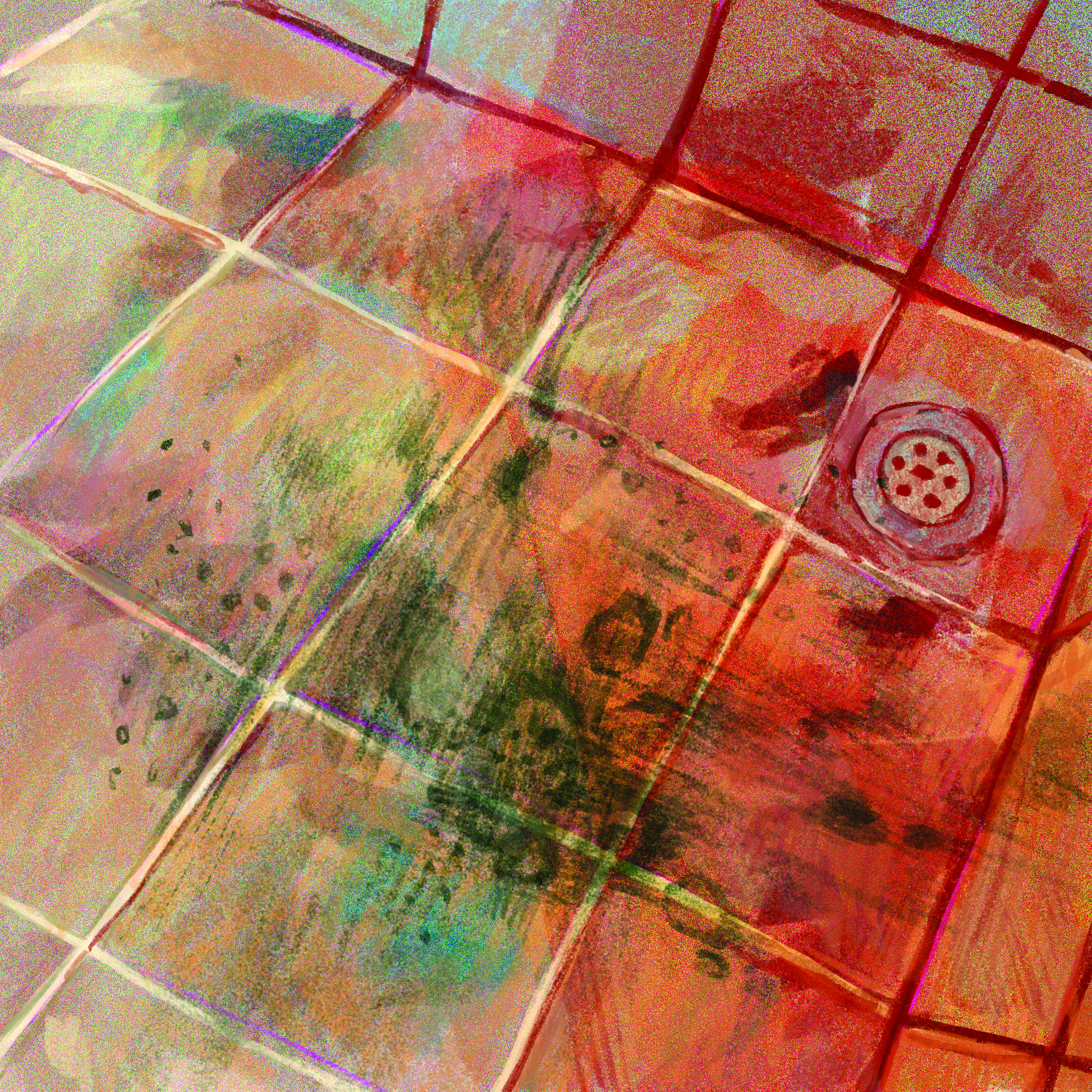
The mold had been in our shower a long time. I was sure that when my parents bought this condo twenty-one years ago, the aged ceramic tiles had come pre-slashed with grime. Every night we stood, barefoot, inches away from the muck. The mold’s sisters—congealed shampoo and matted hair—would congregate every so often at the mouth of the drain, emitting a foul, sour miasma.
I was sure that when my parents bought this condo twenty-one years ago, the aged ceramic tiles had come pre-slashed with grime. Every night we stood, barefoot, inches away from the muck. The mold’s sisters—congealed shampoo and matted hair—would congregate every so often at the mouth of the drain, emitting a foul, sour miasma.
A few years ago, the caulk started to wear out. Water seeped into the narrow gap between the tiles and the wall. Armed with a bottle of Selleys Wet Area Silicone, my mother set out to seal the gaps. But this solution would not last. Pink mold invaded the silicone until every shade of white disappeared. Only then did a handyman layer over the gaps with cement, which came out thick, uneven, and startlingly white. Within another year, pricks of black started creeping back in.
We were never alone, really, in this bathroom the size of a closet. We had the company of the microbes feeding on our bathwater.
The spores travelled up the nasal cavity, through the olfactory epithelium, and into our brains. A mold state of mind, if you will. When cracks began to appear on the kitchen countertop, my mother protected the granite with a silicone sheet. After a while, spots of black mold started to spread. The mold was impossible to scrub off, but I wasn’t prepared for her next move, which was to fit, over the counter, a slab of steel that could well have been pulled from a supertanker.
“The feng shui master told my mother something else: the apartment’s layout was bad for the men of the household.”
As the condo aged, mold-induced repairs of this sort layered on top of each other until I hardly recognized the place, even as all the furniture remained the same. My mother, to her credit, embarked on these projects for our well-being. On the insistence of a feng shui master, she had the entire apartment repainted in our lucky colors to rebalance our vibrations, realign our energies, and retake control of our lives. But the job was done cheaply, and not only did the painters leave several peeling pockets, they also painted over errant pieces of Blu Tack that I had left on the walls. My bad.
The feng shui master told my mother something else: the apartment’s layout was bad for the men of the household. It was too dark; it faced the wrong direction; there was not enough open space. It was no wonder—she nodded solemnly as she told me this—that my father had moved out. To be fair, though, my room is pretty dim. And my father does seem happier nowadays; the bare white walls of his new place bathe in ample sunlight.
I couldn’t help but wonder if the walls that had augured my parents’ divorce had also caused the sorry state of my family relationships. How many times had my brother and I exchanged barbs in this narrow corridor? How many times had I sequestered myself in my room? Had we been doomed from the start?
Perhaps not. But I could see the way we had papered over difficulties instead of confronting them. My earliest memories of my father involve fists banging on wooden desks, vulgarities in a speeding car, and excoriations over a forgotten toothbrush and spilled grape juice. I remember, as a child, cringing as my mother forced me to speak up. Maybe that’s why I often prefer to remain silent. I can’t pin down when my parents stopped loving each other, but for years I could tell.
We don’t talk about those years anymore, in the same way my father doesn’t talk about his mother, who sent him, alone at age eleven, to school in Singapore—far from his Malaysian hometown. Or how my mother, who is still reckoning with the emotional manipulation at the hands of hers, hasn’t spoken to her mother in years. Thus it came to be that we never really ended our arguments, just covered them up. Or that I’ve perfected the art of the entertaining smile before looking back down at my food. It was easy. It was better than the alternative, talking.
Two summers ago, in the middle of a crowded hotel breakfast in Bangkok, my mother first brought up the idea of selling the house when she retires. Over noodle soup, the unknown sank in my gut like congealed drain hair. For all its ugliness, I couldn’t imagine leaving this worn-out condo in the west of Singapore, the furniture that should have been replaced a long time ago, or the haphazard layers of repair. I could not bring myself to speak to her.
The next summer, after I’d returned from my first year at Yale, my mother brought it up again. We were sitting at our dining table in Singapore. As I looked up at her, I realized I had not truly looked at her face in a long time. Her cheeks were starting to sink and a liver spot bloomed under her eye. I thought of the shower floor and the blocked-off countertop, and I thought that the years we had left were not so long anymore. I imagined that for generations now we had, like the mold, festered in the corners of the condo and that maybe the feng shui master had a point after all. I met her eyes and said, “Okay.” ∎
Ethan Kan is a sophomore in Saybrook College and publisher of The New Journal.
Illustration by Angela Huo.