
New Haven is a pockmarked city, riddled with reminders of an era when City Hall thought the only way to save it from economic peril was to tear out row houses and typewriter shops and replace them with beasts of concrete and steel. One of those beasts, the Knights of Columbus tower, looms over one such wound: an asphalt wasteland of parking lots, four-lane streets, and fenced-in parks left behind by twenty years of urban renewal.
Richard Munday says it’s not all bad. He likes how the tower scoffs at the surrounding streets, its colossal brown pillars refusing to perfectly nestle into the corner of Church Street and Martin Luther King Jr. Boulevard. But he’s an urban architect, and urban architects typically prefer cities with fabric, their streets and sidewalks and structures all interweaving into a cohesive whole. This area, between Union Station and Gateway Community College, definitely doesn’t fit that definition. It’s more like downtown’s frayed southern end.
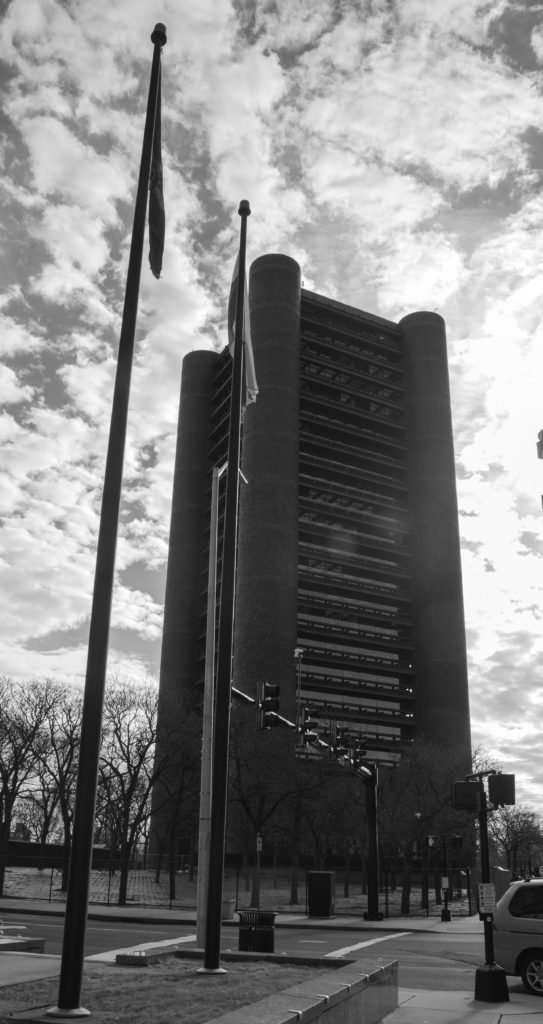
The Oak Street Connector freeway extends westward from the I-95, runs behind the Knights of Columbus tower, and feeds into the base of the former Alexion headquarters a few blocks away. Looking from the tower toward the Connector, it’s hard to remember that this blacktop sea used to be the Oak Street neighborhood, which, according to architectural historian Vincent Scully, was “one of the few [racially] integrated enclaves in New Haven.” Unfortunately for the residents who ran its thriving flea markets and lived in its decaying duplexes, Mayor Richard C. Lee (who served as mayor from 1954 to 1970) considered it a den of “whore houses and gin mills.”
During his tenure at City Hall, Lee buried Oak Street under paeans to the automobile age, like the Connector, the Knights of Columbus tower, and the New Haven Coliseum. A hockey stadium hidden under a four-story parking garage, the Coliseum was demolished in 2007, cheered on by hundreds of New Haveners who thought sparkling new developments would follow. More than a decade later, however, the gash in the city’s fabric remains, stranding residents in the adjacent Hill neighborhood—including the descendants of Oak Street’s refugees—behind the Connector.
More than a decade later, however, the gash in the city’s fabric remains, stranding residents in the adjacent Hill neighborhood—including the descendants of Oak Street’s refugees—behind the Connector.
If Munday and his partners get their way, that will soon change. Munday works for Newman Architects, a local firm that has already designed hundreds of mixed-income apartments and fifty thousand square feet of retail a block over from the empty Coliseum site. Now, they’ve turned their eyes toward the parking lots and barren streets that mark the remains of Oak Street, with the goal of reincorporating this area into downtown. “The development of this area is connected with extending the fabric that you see on that side of George Street, into this area, and then down to the train station,” Munday said. “Suddenly, this becomes not an edge, but a center.” That centering includes extending Orange Street across the Connector and into the Hill, linking it back to the central city.
Newman Architects’ founder, Herbert Newman, has been trying to “knit New Haven’s urban areas together again” for longer than almost anyone else. He has shaped the city’s public and commercial spaces over the last fifty years; the Oak Street revival could cement his reputation for reintroducing commerce and civic life to New Haven. Yet his past attempts to balance the interests of Yale, City Hall, and major property developers suggest that this project could further divide the city rather than putting its pieces back together.
—
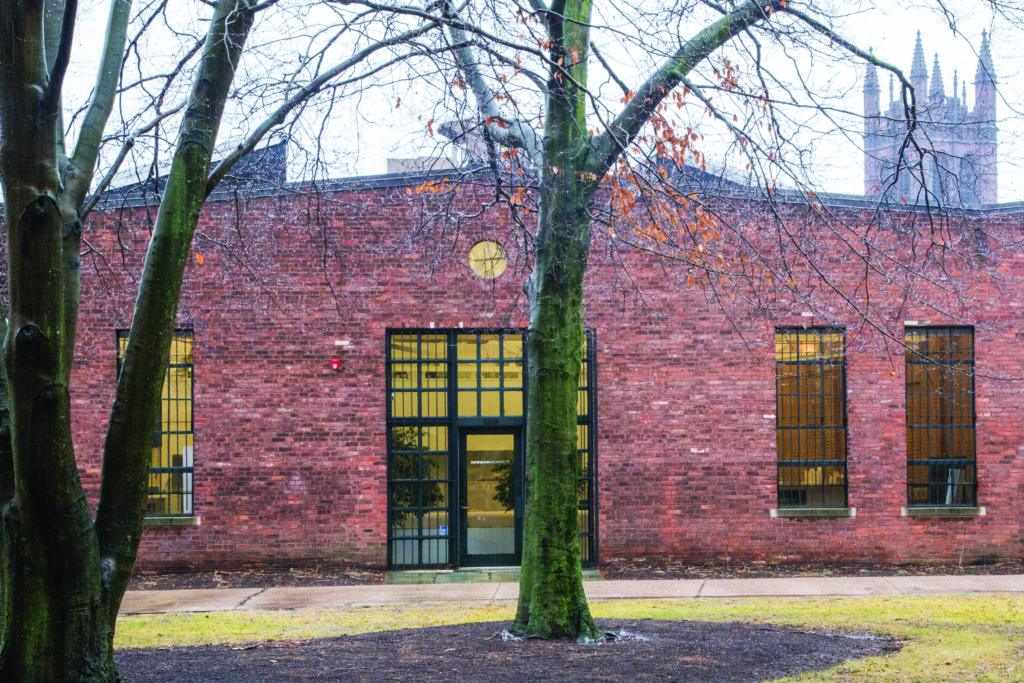
“We proposed—” Newman starts, then stops. He jolts up to snatch some plans off a shelf across the room, walking less like the eighty-three-year-old he is and more like the thirty-something he was when he first opened this office in the nineteen-sixties—no nonsense, impatient to return to his point. Waning November light seeps in through slivers of glass cut into the brick wall, landing on foot-tall foam row houses, new floor plans for a burnt-out church, and a poster that asks, “Can a Public Library Renew Our Civil Society?” Before I can read its answer, Newman is back in his chair, plans on the table. “What we proposed,” he says, pausing for effect this time, “was that we move the city further east.”
By “city,” Newman means New Haven’s commercial core, defined by the Nine Squares. The north-south diamond they form has shaped the growth of New Haven, America’s first planned city, ever since colonial surveyor John Brockett cut them into the landscape in 1638. From his brick box of an office on the walkway between Morse College and Mory’s, Newman is trying to add a Tenth where the Coliseum once stood.
Which sounds, well, ambitious—maybe even impossible. But not if you’re someone who has already designed, renovated, or planned half the city, including Union Station, City Hall, and a magnet school in Wooster Square. Yale Law School, Jonathan Edwards College, most of Old Campus—the list goes on, and on. This is a man who “sees cities as sort-of a tableau, a canvas,” as New Haven economic development administrator Matthew Nemerson put it. Newman mentions this city in the same breath as “Teotihuacan outside of Mexico City, or Jerusalem, or Athens, or Corinth,” and over the last half-century, he has made it his masterwork.
Newman mentions this city in the same breath as “Teotihuacan outside of Mexico City, or Jerusalem, or Athens, or Corinth,” and over the last half-century, he has made it his masterwork.
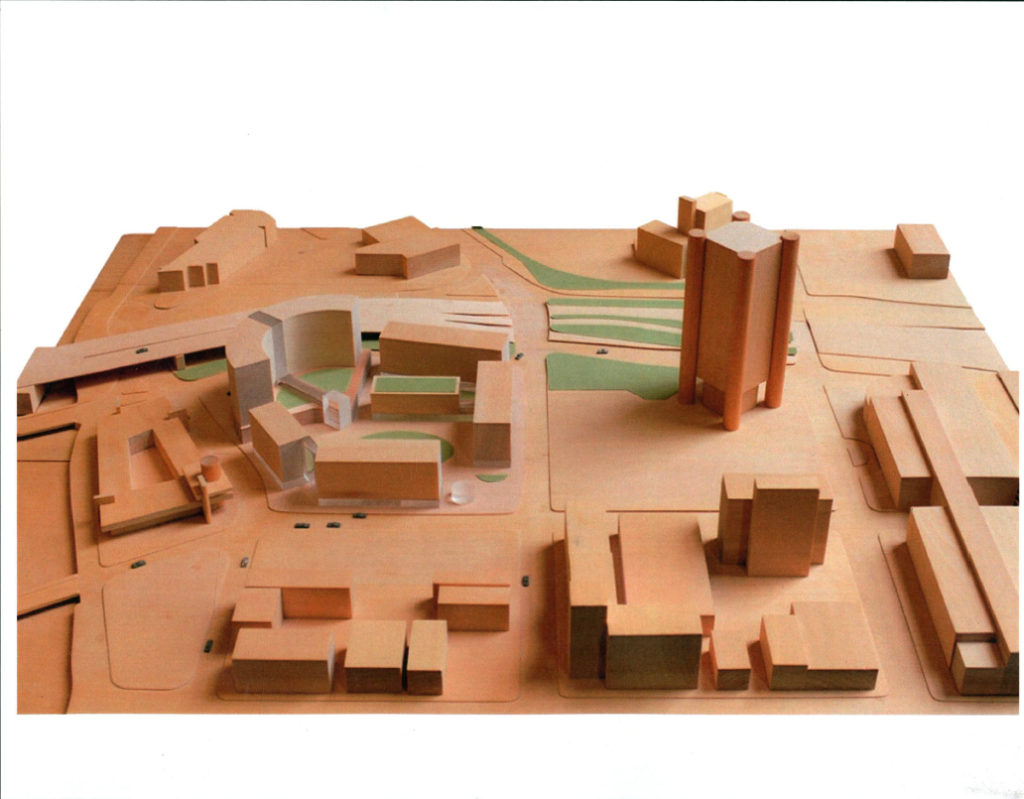
The Tenth Square would be his latest brushstroke. The Knights of Columbus tower and a parking lot the size of a hockey rink now define this part of town, which lies a block southeast of Bow Tie Cinemas and the Omni Hotel. Newman thinks this area, roughly bounded by Union Station, the Ninth Square neighborhood, and the Church Street South housing projects, could become a colony of shops, restaurants, and apartments, all surrounding a new public square. He’s thinking on a scale not typically associated with architects, one at which individual buildings are more like bricks placed in service of a larger whole. “The city becomes the building,” Newman said later. “The city is the architecture.”
That sense of scale reigned supreme when Newman first trained as an architect. He spent his early childhood in nineteen-thirties New York, a city dominated by a “master builder”—and Yale graduate—named Robert Moses who grafted major arteries like the Triborough Bridge and modernist behemoths like Lincoln Center onto the urban grid. By the time his family moved to Waterbury, Connecticut, four-year-old Newman was obsessed with sketching those structures.
“This is a stretch, but if New Haven is Rome, then Waterbury is Florence,” Newman said, remembering how he marveled at the towns of the Naugatuck River Valley. Their grand city halls and railroad stations, built by men made rich by the Industrial Revolution, entranced him.
“This is a stretch, but if New Haven is Rome, then Waterbury is Florence.”
He enrolled in the Yale School of Architecture on the heels of Richard Lee’s 1954 election as mayor of New Haven. Lee would soon try his best Moses impersonation, razing “slums” with federal funds and replacing them with the Connector, the Chapel Square Mall, and the Elm Haven high-rises. Most city planners and urban architects welcomed these transformative projects—Newman’s professors were no different. Yale president A. Whitney Griswold commissioned renowned modernists like Eero Saarinen to design Ingalls Rink and Morse and Stiles residential colleges, while the University’s architecture professors praised the magnificence of marble cubes like the Beinecke Library. Newman’s teachers argued that the best buildings conquered their streets, proclaiming their uniqueness rather than fitting into a preexisting fabric.
Newman learned those lessons on the fourth floor of one such building: Louis Kahn’s Yale University Art Gallery, where the architecture school used to be. Its entrance sits back from the street, perpendicular to and raised above the sidewalk. “That building had a profound effect upon me,” he said. “And, of course, Kahn was there as well.” Kahn’s experiments with “structure, mechanical systems, light, [and] space” amazed Newman. He learned to design and draw from the same men who were constructing “great cathedrals” all around him, testing how far they could go “with these aspirations to build to heaven.”
After graduating in 1959, Newman got a job with modernist architect I. M. Pei, designer of the Louvre Pyramid and the John F. Kennedy Presidential Library and Museum. He commuted between New York and New Haven, where he’d started a family. “I did that by train, early in the morning and back late at night,” he said. “The train was a great place to sleep, but it was [also] a great place to work and read.” In 1961, while Newman had all that time to read, a book came out that would fundamentally reshape how he—and the entire architectural field—thought of cities.
The Death and Life of Great American Cities was written by a little-known Greenwich Village author, Jane Jacobs. She called her work an “attack on current city planning and rebuilding,” one that denounced the buildings Newman had been trained to build as cold, distant, and fundamentally anti-urban. She thought planners and city officials like Moses in New York and Lee in New Haven were tearing down what cities needed to thrive.
“Essentially, Jacobs and others, they saw the joy and the wonder of growing up in neighborhoods where there were street corners where you could shop, and neighbors could meet, and people could sit on stoops and converse with one another,” Newman said. “And people felt safe because they knew who was in the neighborhood and who was not. [Neighborhoods] were lively, they had texture and they had history.” Urban renewal projects ripped those neighborhoods from the city fabric and replaced them with out-of-context modernist objects. The Knights of Columbus tower and the New Haven Coliseum, for example, were simply less personable than the dense neighborhood they supplanted.
“While European cities were destroyed by bombs, our cities were being destroyed by planners. The bombs [were] being dropped by us.”
Newman brought Jacobs’s distaste for urban renewal with him when he left his job with I. M. Pei to accept a teaching position at the School of Architecture and a job working on Yale’s master plan. “It was as if New Haven was part of World War II,” he said. “While European cities were destroyed by bombs, our cities were being destroyed by planners. The bombs [were] being dropped by us.” Working out of a small office on Chapel Street, then quickly moving to his current location near Morse and Stiles, he started on his goal of “replacing the missing teeth” knocked out by modernist planning.
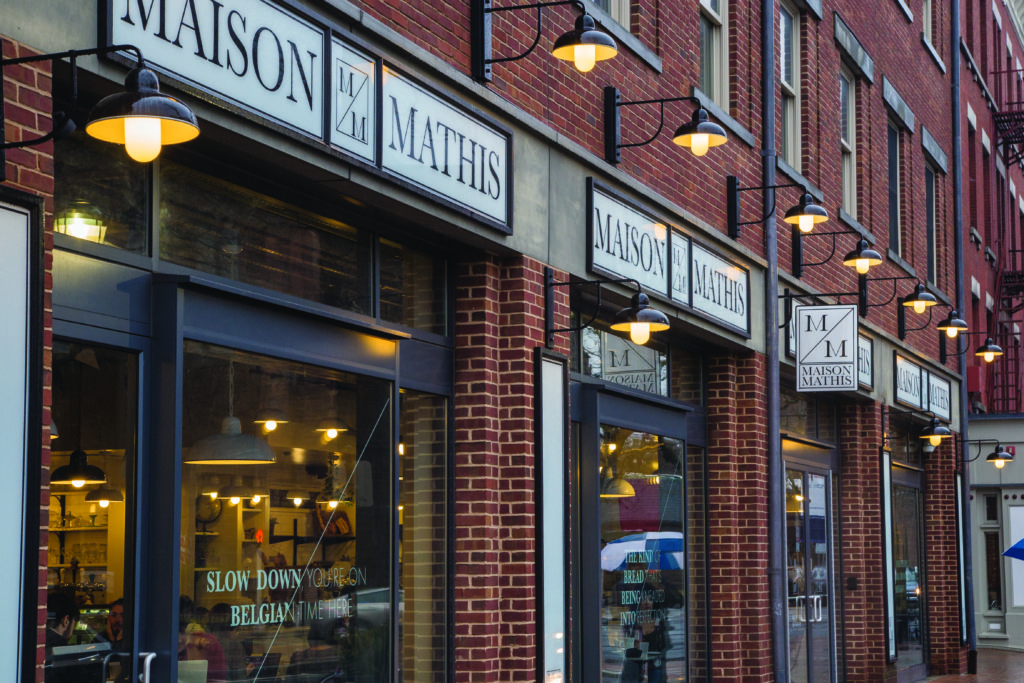
Believing “streets are the most important places in cities,” much of his work in New Haven has involved substituting classically urban buildings, like apartment complexes with shops on the ground floor, for the hulking monoliths and vacant lots characteristic of urban renewal. His firm’s design for Arnold Hall on Broadway, for example, provided space for Belgian café Maison Mathis on the bottom floor, while extending the street’s characteristic brick curtains above. Newman buildings meld into the streetscape, and are often “spectacular when you see them, but invisible when you don’t,” according to Nemerson, the city official.
“He’s not a polemical architect. He’s not about staking out positions,” said Alan Plattus, director of the Yale Urban Design Workshop. “It’s like Herb is right in the middle of things, but not conspicuously.” Over the years, Newman earned a reputation as a “citizen-architect,” one who showed a “genuine commitment to the city” by paying careful attention to history and context rather than trying to build something grand on every street corner.
That reputation was fully established by the time Karyn Gilvarg became New Haven’s city planner in the nineteen-nineties. “Herb and [his partners] will pick up the phone and call you if they are curious about something, or if they think they can help, or if they’re concerned about something they see in the paper,” said Gilvarg, who left the City Plan Department in 2017. The phone line also worked in the other direction, when city officials needed to consult with someone who knew the city’s built environment inside and out.
That’s essentially what happened with the Tenth Square proposal. The Coliseum was a sports and entertainment arena with a garage suspended above it; rusting and poorly maintained, it not only overshadowed Orange Street, but also blocked views of the sky from the surrounding sidewalks. When former Mayor John DeStefano condemned the structure in 2002, Newman saw a chance to reweave the streets it had suppressed into a more cohesive fabric.
When former Mayor John DeStefano condemned the structure in 2002, Newman saw a chance to reweave the streets it had suppressed into a more cohesive fabric.
Many of his ideas for the site had been tested just a block over in the nineteen-eighties and nineteen-nineties, in the Residences at Ninth Square development. On four blocks near Elm City Market, south of the Green and north of the Oak Street Connector, Newman had applied his style to an entire neighborhood for the first time—the Ninth Square was his first large-scale attempt “to put the smile back in the mouth of New Haven.” His love for intimate sidewalks and storefronts mixed with the flair for grand gestures he’d learned as an architecture student, leading to a project that some “wish we could keep repeating” throughout the city. Others think it only deepened New Haven’s economic divisions.
—
“This is a drawing of the Ninth Square,” said Munday, Newman’s colleague, showing me a computer-generated skyline with the Ninth Square lit brightly orange. Newman, now wintering in Florida, had sent me back to his firm’s office to look at plans for the neighborhood. “It was mainly warehouses and small businesses,” Munday continues. “Then, during the period of the nineteen-sixties and nineteen-seventies, it emptied out. All those businesses disappeared. What was left were largely empty buildings, or very underutilized buildings.”
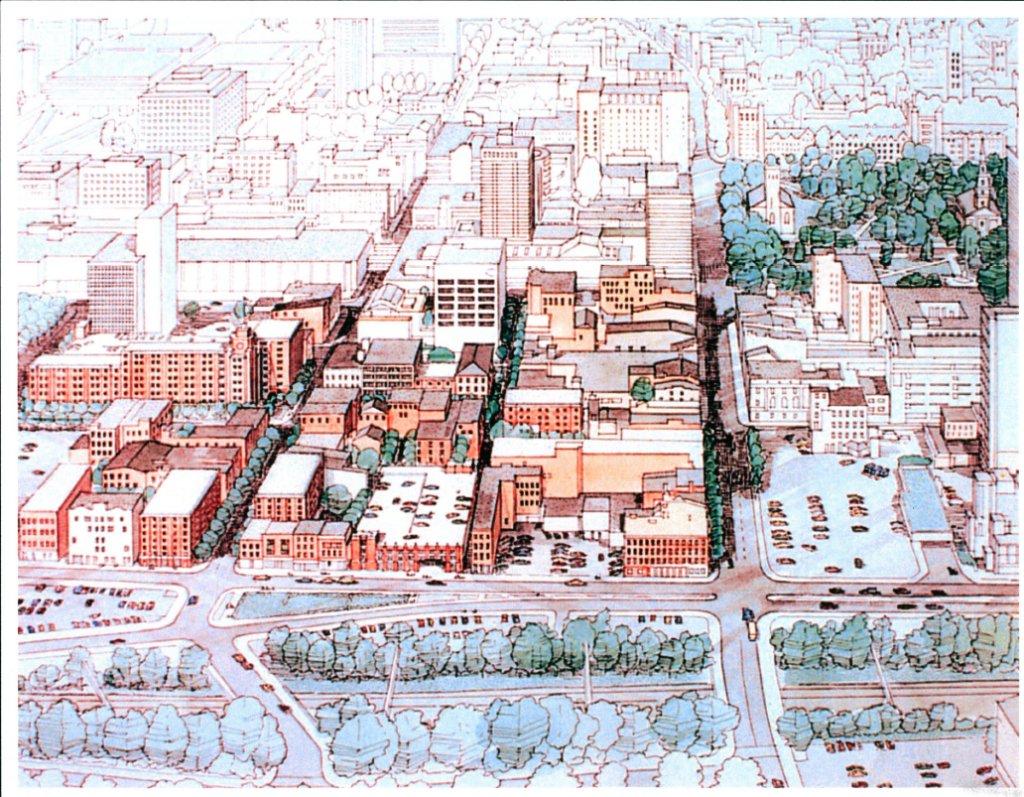
Before the neighborhood’s decline, five-and-dime stores like W. T. Grant and Kresge’s sold everything from parakeets to dish soap, while Horowitz Bros. sold zippers, fabric, and other sewing materials. One store sold only buttons. “It had this faded museum quality that might’ve been very charming, but was not economically very viable,” said Gilvarg, the city planner.
The displacement of Oak Street’s residents, along with white flight to the suburbs, cost those stores many of their shoppers. Facades fell apart and vacant lots cropped up. “New Haven was in pretty bad shape,” Munday said. “There was a pretty strong sentiment that cities were on their way out, that there was no future for cities, really.”
“New Haven was in pretty bad shape,” Munday said. “There was a pretty strong sentiment that cities were on their way out, that there was no future for cities, really.”
In 1989, Newman and his firm produced a master plan to guide real estate developers McCormack Baron and The Related Companies in their revitalization of the Ninth Square. The plans called for the renovation of existing facades and the construction of infill apartments and garages that would unify the streetscape. Altogether, they built 335 mixed-income apartments, with fifty-thousand square feet of ground-floor retail. All the new buildings—including the garages—were covered in orange brick and green window frames to create a unified aesthetic. “They fit in,” Gilvarg said. “They don’t look like fake, plastic copies of historic buildings.”
The ideals driving Newman’s design, however, ran up against the realities of modern-day development. To remake the urban fabric, the area’s stragglers needed to leave, at least according to the developers and the city. Twenty-five businesses were forced out, leaving “an eyesore of graffiti, soaped windows, and boarded up storefronts,” according to a Yale Law School paper written by law student Christopher Miller.
Written in 2011, Miller’s paper captures how difficult it is to create community-oriented living through idealistic design. On one afternoon, Miller saw three middle schoolers playing in a courtyard in the new Ninth Square development, their parents watching them. “After about five minutes a manager came over and walked between the parent and her sister to castigate the children in front of them. ‘No, you are not supposed to play out here, you are not allowed to play ball out here!’”
The development’s sidewalks have plaques that memorialize notable community members, but many of the shops, “designed with the downtown office crowd in mind,” are “prohibitively expensive for the average subsidized tenants,” according to the paper. Restaurants like Barcade and 116 Crown price lower-income tenants out of the city fabric that Newman wove back together.
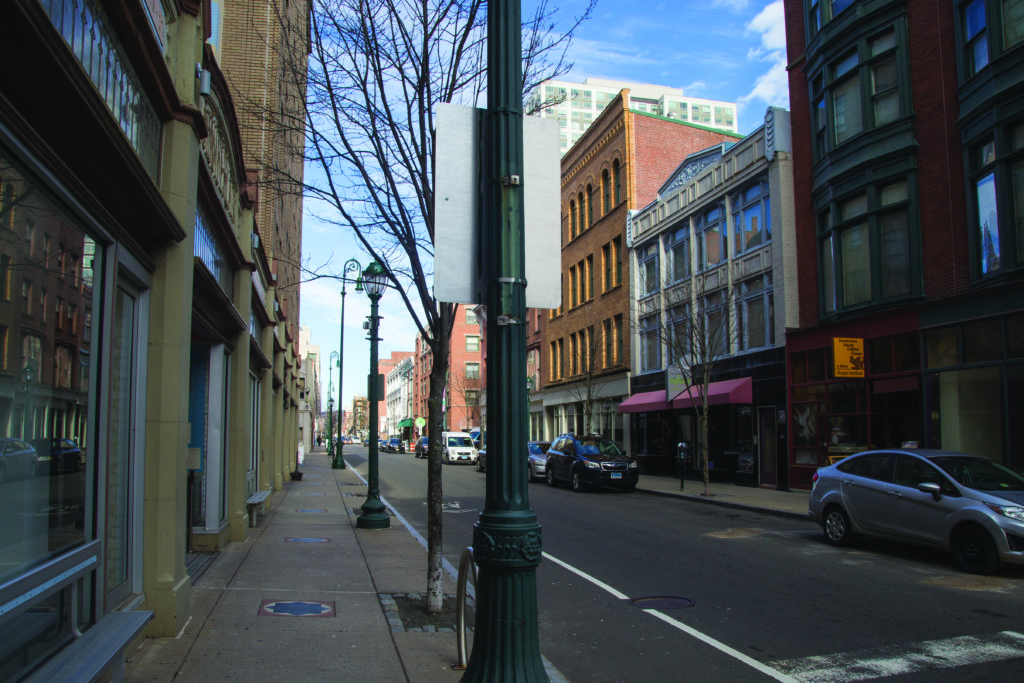
Influenced by Jane Jacobs, most architects and planners today would prefer Newman’s contextual, street-based designs over the monumental modernism of Mayor Lee. His designs were meant to welcome all kinds of residents. “I would argue for diversity,” he said. “I would argue that we should not just have shops which have national recognition, which can afford very high rents, and make it a classy place like Rodeo Drive or…Palm Beach.”
And yet it’s impossible to separate Newman’s redesign from the gentrification that followed. This paradoxical relationship, between inclusive designs and somewhat exclusive results, is even more apparent in the firm’s follow-up to the Ninth Square: Broadway.
—
Broadway, in many ways, is the quintessential expression of Newman’s architectural philosophy, which boils down to three words. “It’s path, it’s place, and it’s portal,” he said. “At the confluence of paths, you can make great places. At those places, you can make portals, which create special points of squeezing people to come together to enter a place.”
Sitting at the intersection of paths like Whalley Avenue, Goffe Street, and Elm Street, Broadway is a place that straddles the divide between Yale’s central campus and Dixwell, a historically black New Haven neighborhood. Properly designed, Newman argued, Broadway could act as a portal through which city residents and Yale students could be introduced into one another’s spaces.
It definitely wasn’t serving that role when Newman set up shop off Broadway in the nineteen-sixties. New Haven was struggling with poverty and crime, the fruits of urban renewal and deindustrialization. Yale had built most of the residential colleges in the thirties; its twelve gated courtyards, including a few right across from Broadway, choked the connection between the campus and Dixwell.
But by the nineteen-eighties, the city’s reputation had deteriorated to the point that Yale started to worry about admissions numbers. Administrators concluded that since the university could not close itself off from New Haven’s problems, they needed some kind of buffer zone between the campus and the city. So a new tactic arose: investing in properties adjacent to the university.
Broadway still had several thriving businesses in the nineteen-nineties, including the Yankee Doodle Coffee Shop and Cutler’s record shop. But, according to Newman, the relative lack of shoppers made the presence of panhandlers across the street from undergraduate housing more obvious. Students in the architecture school had been reimagining Broadway as part of their coursework for years. Yale took those ideas, and hired Newman to run with them. “It was Yale turning its face, rather than its back, to the city,” Newman said. “We were the instrument.”
His firm seemed the perfect team for the task, having been located just off Broadway for thirty years. When Newman was hired, you could still conceivably claim his offices were on the dividing line between college and city. The fact that Nemerson, the city’s economic development chief, could characterize the neighborhood today as “the epitome of Yale” speaks to how effectively Newman’s redesign rebranded the street. Widened brick sidewalks, narrowed roads, cast iron fences and lampposts, American elms that hid a central parking lot—with these modifications, Newman Architects facilitated the creation of “The Shops at Yale.” Sprucing up the street made it much easier for Yale to rent out Broadway properties it had bought up, which in turn brought more pedestrians to the area.
“It isn’t that there’s less panhandlers there now than there were in the nineteen-sixties and nineteen-seventies,” Newman said. “Many of them are the same people that I’ve known for fifty years on those streets.” He says the number of panhandlers, “fundamentally safe” people “trying to make a living,” has stayed the same, but the increase in shoppers has improved the street’s reputation.
Broadway isn’t a sort-of urban utopia, the kind of thing Jane Jacobs might hold up as a model of dense, integrated urban living.
That may have truth to it. But the street isn’t a sort-of urban utopia, the kind of thing Jane Jacobs might hold up as a model of dense, integrated urban living. Shoppers from the suburbs, having parked in the elm-lined parking lot, don’t often stop to speak with the locals waiting under the newly painted bus shelter. And any panhandler would be hard-pressed to collect enough money to buy anything at most of the stores on the street, as Barbour, Lou Lou, and a dozen other “unique boutique[s]” have replaced the diners and record shops.
“That is a danger, no question about it,” Newman said about Broadway’s gentrification. “The university is in a unique position to be able to balance the aspirations of its real estate holdings with those of its students, and all of the citizens and people who live in New Haven.” It has failed so far, in the eyes of those who consider the street an extension of the “Yale bubble.”
Munday, the partner at Newman’s firm, pointed out that Broadway has always been a shopping street, and that “commerce is at the heart of cities.” And there’s an argument to be made for high-end shopping districts, whose properties can be taxed substantially to fund public services for struggling areas. But a gentrified city street doesn’t quite live up to Newman’s inclusive vision. His brick sidewalks effectively claimed the street for Yale, making it less of a portal and more of a boundary.
—
Newman’s role in Yale’s conquering of Broadway seems almost like the payment of a debt, whether the architect intended it to be or not. The University not only gave him his degree, but also offered him his first job in a city he reveres. It invested $12.5 million in the Ninth Square redevelopment, which Newman says “wouldn’t have happened without Yale.” If Newman has his way, something similar could happen with the Tenth Square.
“That’s an opportunity here,” Newman says, hitting the table in his office for emphasis. “Some people at Yale would argue that, ‘Well, the Coliseum site is a little far away’…I don’t believe that. New Haven is a small town. Each of these tendrils, they reach out and they call to each other.”
The Tenth Square project has been mired in delays since 2011, when Newman officially signed on to create a master plan. The original plans for the site stretched across six city blocks, including a new community college on Church Street, residential, retail, and office space on the Knights of Columbus and Coliseum parking lots, and infill buildings on the other side of George Street. Newman’s designs called for a grand, tree-lined avenue parallel to George St., the kind of public street that “make[s] you proud of being a citizen of a city like New Haven, because you’re there with everybody else,” he said.
Importantly for the Hill, the plans also included an extension of Orange Street over the Connector and into the detached neighborhood. It would become a path that connected residents of Church Street South to the new civic hub, and downtown as a whole.
Yet, in 2018, nothing has been built. The developer, LiveWorkLearnPlay, has had trouble financing the project. Delay after delay has forced the firm to rein in its plans. Gateway Community College went up on Church Street in 2012, but it wasn’t designed by Newman. The Knights of Columbus have backed out of building anything on their lot. Most of the residents of Church Street South were relocated after the federal Department of Housing and Urban Development judged it uninhabitable. The Tenth Square now only includes the lot on which the Coliseum once stood.
The Tenth Square could be the last floor he adds to the building that is his city, a final statement of what New Haven should look and feel like, of how its residents could interact with one another.
That lot is still big enough to host almost one-thousand apartments, along with thousands of square feet of retail space. But Newman has gone from his late seventies to his early eighties since signing onto the project. The Tenth Square could be the last floor he adds to the building that is his city, a final statement of what New Haven should look and feel like, of how its residents could interact with one another.
And it’s hard to know what that statement will ultimately be. Newman is known—even loved—for helping rebuild New Haven after the ravages of urban renewal. Yet for all his adoration of Jane Jacobs’s sidewalks and storefronts, there’s evidence of a modernist streak left over from the days of Kahn and Moses and Lee, one that compels him toward the creation of modern-day “cathedrals” even as he acknowledges the failures of the old.
For all his emphasis on inclusivity, his two largest projects have contributed to gentrification. This citizen-architect, earnestly trying to build the city for all, has been caught up in Yale’s incursions into nearby neighborhoods. Spaces like Broadway and the Ninth Square are well-designed, civic, and enjoyable, but often only if you make enough money. If the Tenth Square gets built, only to be filled with more “unique boutiques” and Barcades, then the philosophy of path, place, and portal will fall short of filling the holes created by urban renewal.
— Robert Scaramuccia is a junior in Trumbull College.